Skip to content

Collaborative learning and group work: the why and the how

Collaborative learning and group work.

Of late there appears to be a growing scepticism towards group work as an effective instruction tool. Teachers on social media explain how they were once forced to use group work during teacher training or in their schools despite their own reservations. The charges levelled against group work can generally be summed up as: the task set doesn’t necessitate group work, it can be disruptive and noisy, teachers are uncertain of their role during group work and there could be disguised inactivity with some pupils “social loafing”. While I understand the reservations raised, I’d like revisit why group work is effective when used selectively and when pupils are given explicit guidance on how to work successfully as a group.

Cooperative learning effectiveness

First, it’s worthwhile recalling that group work or “collaborative learning” tends to rank positively in terms of effect sizes. In the EEF toolkit “collaborative learning” is ranked fourth on their list providing an additional five months progress when deployed effectively.

As the EEF suggests: “The impact of collaborative approaches on learning is consistently positive.”

Although it adds the important proviso which we’ll return to:

“However, the size of impact varies, so it is important to get the detail right.”

This is supported by other studies such as Johnson and Johnson’s meta-studies and has been documented in numerous publications such as Marzanno’s “Classroom instruction that really works”.

So why the lingering suspicion towards collaborative learning methods? My experience developing Let’s Think in English suggests the majority of classes can’t automatically work effectively in groups and unless teachers are aware of how to support pupils the process breaks down causing understandable frustration. Knowing more about the theoretical underpinning behind cooperative learning methods and having strategies to develop in the classroom can avoid many of the pitfalls for group work and associated frustrations.

Cooperative Learning theory

Cooperative learning has its roots in social interdependence and is influenced by cognitive-developmental psychologists such as Piaget and Vygotsky and behavioural learning theories from Bandura and Skinner.
Cooperative learning theory has evolved since the 1930s and was influenced by John Dewey, Kurt Lewin and Morton Deutsch. Dewey advocated cooperative learning as preparing students for democratic society and stressed the active engagement individuals gained from sharing their own and being exposed to the ideas of others. Lewin emphasised the need to establish relationships between group members while Deutsch proposed the need for positive social interdependence between group members.

The theory was subsequently developed by David and Roger Johnson who undertook meta-analysis of cooperative learning:

Effects of Cooperative, competitive and individualistic goal structures on Achievement: A meta-analysis
Psychological Bulletin, 89:1, 47- 62.
(1981)

And
Cooperative learning methods: A meta-analysis.
(2000)

The findings of these meta-analyses were positive and suggested cooperative learning was effective.

Johnson and Johnson in An Educational Psychology Success Story: Social Interdependence Theory and Cooperative Learning (2009)

outlined five variables that mediate the effectiveness of cooperation:

• Positive interdependence
• Face to face interaction
• Individual and group accountability
• Social skills
• Group processing

Interestingly there are parallels between the variables here and the key characteristics of teams in top performing organisations as identified by Daniel Coyle in his book “The Culture Code: The Secrets of Highly Successful Groups”. Coyle outlines the following key characteristics when exploring successful teams in business and beyond:

• Everyone in the group talks and listens in roughly equal measure, keeping contributions short.
• Members maintain high levels of eye contact and their contributions and gestures are energetic.
• Members communicate directly with one another, not just with the team leader.
• Members carry on back-channel or side conversations within the team.
• Members periodically break, go exploring outside the team, and bring information back to share with others.

What does this mean for the classroom?

Well first it’s important to stress that while I’m an advocate for group work, I think it should be used when appropriate. Group work is helpful when the task one sets has a desirable difficulty and when individuals might respond differently or have different solutions to a set task therefore enabling them to critically evaluate different responses. In Let’s Think in English we have group work in every lesson as texts by their nature are viewed differently, we believe different viewpoints are worth exploring and sharing of opinions is important in developing reasoning. Furthermore, we set pupils challenging questions around the text, so they have to think hard. In this situation group members can support one another to tackle the challenge by critiquing, building and responding. However, the bridging – applying knowledge and skills in new settings- that takes place after an LTE lesson may be undertaken in groups or individually and as in all lessons the teacher is best placed to judge which method to use and why.

Within Johnson and Johnson’s five variables lie strategies that teachers can deploy to ensure pupils work effectively.

Positive interdependence

Positive interdependence refers to students fully participating and being aware they are responsible for their learning and that of the group. In my experience participation drops for a range of reasons once group size is increased. Simply put the more pupils there are in a group the harder it is to have your voice heard and to listen and respond to others. Say you set a task for a group of 6 pupils and give them two minutes to complete the task. If the time is distributed equally that would provide each pupil with 20 seconds to share their thoughts, listen to others and respond. In reality only 2 or 3 more confident pupils will have the opportunity to respond. Interdependence is increased when group sizes are small, and pupils have the safety, intimacy and space to speak. listen and respond. I favour a group of 3 for this reason. A challenge with groups of 3 is taking feedback from each group but this is not usually necessary as one can establish the common position held by the class and the explore alternatives or build upon the points shared. The key point is teachers should find what works for them best.

However decreasing group size alone is unlikely to increase interdependence. Pupils need support in turn-taking. Classrooms are often hierarchical structures with some pupils being aware of their efficacy in a subject. Similarly, in some classrooms the high attainers are forthcoming and used to being invited to air their thoughts while low attainers may be less confident. This relationship is likely to continue into group work with some pupils dominating while others appearing passive. A simple means to encourage individual and group interdependence is to number the individuals in the group and for the teacher to decide who starts the talk to ensure turn taking.

If you’d like an insight into the underlying hierarchies in your classroom allow the pupils to number themselves; usually the confident and/or high attainers will choose to be number one. When commencing the group work ask the number three in the group to start and watch the incredulous look on the number ones’ faces. In some cases, the self-allocated number ones will start the talk/task regardless and will need reminding of the agreed order. With time though interdependence becomes the norm and pupils will start to adopt turn taking and encourage the involvement of others automatically.

Interestingly many teachers who we’ve trained in LTE have used these simple techniques with other classes to good effect including A’ level classes to challenge passivity.

Key take away: Keep groups small and number pupils to ensure turn taking.

Face to face interaction

Face to face interaction refers to pupils promoting each other’s success and explaining or assisting one another with explanations. In classrooms I’ve found a paradox that many classrooms environments that appear to be designed for group work often prove problematic.

Picture a typical primary classroom set up for cooperative learning. It is likely to have a number of very large tables with six pupils surrounding each table or alternatively three rectangular tables nested together with two lying perpendicular and one turned sideways at the top with a pair. The initial appearance is these are classrooms designed for cooperative learning but if the task involves discussion it proves very difficult; pupils struggle to hear each other and typically break off into pairs and speak to those immediately next to them. When a group breaks down in this way individual pupils are often cast adrift from the talk and will lose the thread of discussion and lesson.

If we return to Coyle’s characteristics of a high performing groups, he highlights:

• Members maintain high levels of eye contact and their contributions and gestures are energetic.

The closer together a group is the better. Groups should ideally be enclosed and facing inwards towards each other and pupils should be encouraged to respond through subtle gestures as their peers speak. While many might look at a classroom laid out in rows as non-conducive to group work, I’ve found them easy to navigate as you merely ask individuals to turn and form a group with peers behind them which ensures close proximity.

What is more problematic is ensuring attention when groups provide their responses to the class, but I’ll address that in a future blog on listening in the classroom.

Key take away: Ensure pupils are sitting close together when undertaking group work so they can hear and see each other. This does not mean you have to have to change your classroom layout.

Individual and group accountability

This refers to each student showing mastery of the content studied and being accountable. So how can we achieve this and avoid the “social loafers”. In Let’s Think in English we advise teachers to always select who provides feedback from the groups rather than permitting the same pupils to respond for their groups. However, it is worth noting this is different from “cold calling” where a pupil is randomly selected to answer a question. In this instance a pupil is selected to feedback what their group has been discussing so they’ve enjoyed the opportunity to clarify their own and listen to other pupils’ thoughts. Where pupils are shy or less confident one can inform them, they will be providing the feedback for their groups in advance and provide time for the group to summarise their thinking. For many pupils explaining the thought processes of their peers, enables them to better understand a standpoint than merely listen.

However, our work in Let’s Think in English has illuminated a common problem with group work in classrooms: the feedback pupils give is frequently not reflective of what the group has been discussing. When pupils are new to LTE, they will often respond to a request for their group thoughts by saying “Well I thought the character….”. This happens as while the pupil has individual accountability, they do not yet have group accountability; they do not see the value of the group discussion and feel having an answer is all that matters. Similarly, when new to cooperative learning pupils may engage in group work but when asked to respond ignore the group discussion and return to their very first thought about the text. Pupils need to be supported to actively engage with the group discussion and critically evaluate the talk that is shared by considering questions like: Do I agree with that? Can I add to that thought? Is it reasonable and can be supported with evidence?

To support pupils to be accountable to their groups in LTE we encourage pupils to start their group feedback with the expression: “We thought…” or “Our group said…”. This sentence starter focuses the pupils on providing representative feedback rather than their own individual thoughts. Furthermore, if pupils say “We thought…” but in fact represent their own thoughts only, their peers are more likely to challenge them.

It is key teachers consider their language when requesting feedback from pupils. If a teacher asks: “Jane what did you think?” when seeking group feedback it is likely Jane will merely provide her own thoughts , whereas if the teacher asks “ Jane can you share your group’s thoughts?” they are likely to receive representative feedback.

Key take away: Select which pupils provide feedback from their groups but note this is different to “cold-calling” as pupils have rehearsal time. Ensure feedback is representative of the group by encouraging pupils to use “We said…” and considering how you frame the request for feedback.

Social skills

This refers to pupils developing social skills such as: leadership, decision-making, trust-building, friendship, communication and conflict management. In the classroom this means you need to carefully consider who works together in a group but also you may need to provide individual targets, so pupils develop specific skills. Feedback from LTE teachers suggests they often spend their first lessons with a new class considering and revising their groupings. Mixed-attainment groups work best so long as the spread of attainment levels is not too wide although teachers’ perception of individual pupils’ attainment is often challenged in LTE.

Beyond pupils’ attainment levels, teachers suggest in group work they also need to consider pupils’ social skills. While some teachers have occasionally placed their dominant pupils in one group, they usually twin a confident pupil with a less confident one. However, over time it may be necessary to give targets or roles to individual pupils to ensure they develop the social skills required. For example, with a dominant pupil you might ask them to adopt the role of group facilitator while discussing a particular question to encourage their adoption of this behaviour over time.

Key take away: Consider how you group pupils carefully and intervene and set targets for individual pupils to support their development of social skills.

Group processing

This refers to reflection on individual actions and how successful the group was in achieving their goals. In my experience pupils enjoy well-structured group work as they are active in their learning and feel empowered by seeing their thoughts are valued. However, it is important they realise why and how working as a group has developed their learning. Some pupils are able to do this autonomously and will say: “I’ve changed my mind now because of what X has said… Their argument makes more sense because…” Yet other pupils will need support in tracking the flow of group responses. The teacher may highlight how an idea has developed and grown during group work and subsequent feedback by saying “So we now seem to think as a group…., although at some point we thought… this all seemed to have started from x’s idea.’ Pupils need to be aware of how cooperative learning and group work is supporting them to learn.
The suggestion of reflection lends itself well to metacognition and supporting pupils to be more consciously aware of how they are thinking and therefore able to control, monitor and evaluate their thinking better. While many of the recent publications on metacognition such as the EEF’s Guidance Report, have considered it largely as an individual development there are distinct advantages of developing metacognition together. If we see metacognitive knowledge characterised as combinations of information around three knowledge variables –self, task and strategies – that will be effective in achieving goals (Flavell 1979) then there are advantages to being exposed to the way others’ approach a task and strategy as it makes us more aware and in better position to evaluate our own approach. Group work enables pupils to plan, monitor and evaluate as a group; rehearsing a process that can be developed on an individual level.

Key take away: Support pupils to see the value of group work by tracing the development of ideas and group work can support pupils develop metacognition.

Conclusion

In summary I’m suggesting that despite negativity towards group work and cooperative learning approaches in some circles it is still a very useful instructional method as supported by the evidence. As with all instructional methods it depends on how and when you use group work and I’ve suggested the majority of pupils will benefit from explicit guidance on how to work effectively in groups. The strategies above are relatively straightforward to implement and teachers suggest that after 3 to 4 lessons working in this way pupils start to become familiar with it.

Let’s Think in English online?

Let’s Think online? A conversation with Myfanwy Edwards
by Leah Crawford

Let’s Think is a classroom intervention whose powerful ticking engine lies in the social construction of understanding. The safe, meaning making community that we work so hard to develop over time, is built on carefully mediated dialogic exchanges. Yet we know there are dimensions of communication beyond the words spoken: body language, eye-contact, tones of voice, the positioning and creation of groups, the sharing of resources.

Even on the return to live teaching in school in September 2020 there were additional challenges to teaching Let’s Think with restrictions on the seating, grouping and movement of students and teacher. Michael Walsh, LTE lead tutor helpfully blogged about ways we might manage these restrictions here.

Some schools have understandably felt that Let’s Think lessons will be on pause for the early Spring Term whilst we are teaching remotely. So, when I read on the Twitter grapevine that Myfanwy Edwards, English Subject Leader at the new Richmond Upon Thames School in Twickenham, would be continuing to teach Let’s Think in English remotely, this small case study felt like something worth capturing for the whole LT community. It’s a work in progress, but Myfanwy and I captured the story so far via a Zoom interview at the end of January.

So Myfanwy, let’s just set this in context. How long had you been teaching Let’s Think before you moved to your current subject leader role?

I taught LTE for 4 years at my previous school. I felt lucky that there was a core of us who were really committed to the programme and to continued teacher development. We were in and out of each other’s classrooms, observing and reflecting and adapting practice. I think this helped me to establish some key principles that I still believe in.

So what were those principles?

For me, they are the principles on which all good teaching of English is based and actually, we used them as principles for planning and teaching in the rest of our curriculum. The importance of talk for collaborative meaning making is foremost: it didn’t take much persuasion for me to believe in this. It’s strange now looking back, I started Let’s Think with a Year 7 group that first year and I took them all the way through to Year 10. Although we did not use the KS4 lessons, they were so well versed in how to build meaning together, they understood that English is not individualistic or competitive and that they would benefit from building understanding together, that it was so easy by Year 10 to just set a group task or question and I knew they would make something from it.

Now having done more training with my new department, the aspect that I did not fully grasp the first time around was the discipline of the Reasoning Patterns: having just one conceptual focus for each lesson. For every rich text in English there are so many angles you could take, but a Let’s Think lesson takes a disciplined route through one concept, yet still gives room for students’ own route to understanding this. I like the way that the Concrete Preparation section lays the ground-work for this direction in thinking, and offers you ways you can use in other lessons. I think I’ve particularly learned how introducing the context or even the author does not have to be at the start or before reading a text, but can be woven in later to add a new dimension to thinking. I like that sometimes context and author are not introduced at all and that lack of resolution keeps thinking open and bridgeable to the next context, like in ‘By the Sea.’ So I think overall, I like the disciplined, structured plan, but with enough flexibility for students to make their own meaning.

Another school of thought is to ask students what is of interest to them, what they notice in a text and work with this. I think if this is used in tandem with Let’s Think, the students learn how to use the freedom. So just last term, my Year 7s having worked though The Bridge introductory lesson, were confident in working through who was to blame for a tragedy in their set text, because they had internalised the process. That’s the metacognition principle. It really works if you plan that disciplined training, then an opportunity to reapply.

So my next question Myfanwy was around your decision to ask Michael Walsh to train the whole of your new department in September 2020, even though it could not be a face to face development day and had to be remote training on Zoom. I can extrapolate from what you’ve said that it was about the importance of collaborative meaning making, the disciplined training of reasoning, the metacognition and bridging to reapply that thinking. But why did you not wait until the training could be in person?

It was linked to the lockdown.

Kids had been sitting alone in a room, maybe talking to siblings or friends on social media, but nothing like the disciplined collaborative meaning making we manage in class, say around a poem. We felt we needed to retrain the students and I wanted to give the staff in my new department the structures and development and confidence to manage this. Michael is great, too, he helps you enter the programme on all sorts of levels: the pure cognitive growth angle, the democratic principle, the nature of literary making meaning. I’m interested in what students have to say.

So the way we have taught The Tempest with Year 7 remotely has shown that they know how to ask good questions of a text without the need for us as teachers to front load all sorts of colonial context. In fact, the main contextualising I did was to imagine what it would be like to be in a shipwreck. Then we read the opening scenes and they needed no prompting to ask why Prospero feels it is his right to be ruler of the island and that saving Ariel doesn’t necessarily give him that right. It then felt like a natural development to move to questions of Colonialism and slavery.

So it sounds like you were already seeing an impact on Year 7 from teaching Let’s Think in that 2020 autumn term?

Absolutely. The exchange of prior knowledge is so much more noticeable in pure mixed ability classes. I’ve done some recordings where you can hear the ripple in the Vygotskian shared ZPD! But also how quick they have been to become more aware of how they are reading and can reapply a process.

Did you hear teachers talk about their practice shifting?

Yes, I have a teacher with 11 years experience, who asked if we could adapt the whole Year 10 poetry GCSE unit using the principles of Let’s Think, interleaving some of the GCSE lessons with anthology poems, like the George the Poet and Blake lesson on London. I wondered if a more experienced teacher might be harder to convince but that wasn’t the case because she was so encouraged by the level of interest and understanding in the students’ responses. Then there is my reading co-ordinator who is using Let’s Think as a lens through which to view her teaching of A Christmas Carol for her MA, again because of the quality and independence of responses.

So there was enthusiasm, there was quite swift influence on the curriculum and teaching beyond Key Stage 3. But teaching Let’s Think via remote live contexts presents a whole new challenge: what made you want to continue?

I think if anything having to teach online has sharpened all of our principles. What is really important to us and how can we ensure that that still happens online? So, we have a focused teaching and learning department meeting every fortnight online. So far, we have discussed: How can we incorporate Assessment for Learning? How can we enable collaboration? and How can we include personal response? There is no point in having principles if they go out of the window as soon as they are challenged. So one of the most important things has been keeping the idea of the ‘third turn’ – avoiding the closed shop of teacher initiation, student response and teacher feedback, but instead folding student response back in to the thinking and further responses of the whole group.

That’s hard in the chat box, I’ve found, particularly when some students don’t have a microphone or are in a context where they can’t unmute and say more about their answer.

It is, but we have worked on us using the chat box comments to summarise where their thinking is, to make links between what students have said ‘So, Louis seems to be saying something similar to Ashton there.’ Then asking ‘Do you agree or disagree with that shared point’. It’s not the same, but they are contributing and it gives the sense of a conversation and a communal effort. You can also offer provocative statements related to the question to open up the level of contribution. The London, Blake and George the Poet lesson worked particularly well with Year 10. It was easier to do online with the video link, so that I could set this as an independent task – a breather – in between. We said, go away then post in the chat what you think. And that level of contribution feels even more important at the moment for student well-being. The idea of moving straight to an analytical paragraph, on your own with a grid to scaffold doesn’t feel right, when we could be asking: What do you think and feel about this?

So let’s just pause here for people who might be reading this and thinking of trialling a Let’s Think lesson online. You have mapped one lesson across two, to give thinking and reflection time?

Yes, so the London lesson was across two lessons. I will give them a screen break to reflect, then return and there is a shared Google doc with the text broken into sections and the student names in groups next to a section of the text, so they can add their thoughts on that section and begin to respond to each other. And I can nominate one student in each group to get ready, come off mic and summarise the group’s thoughts from what has been typed into the shared document, just as we would in a classroom Let’s Think. Another of my colleagues encouraged and gave the students time to text, phone, or Snapchat before entering group thoughts. I think that’s the reason I would most encourage other teachers to try Let’s Think, is that you are encouraging, you are making the space in the school day, for students to talk to each other about something rich and share what they think.

So the idea of walking away, or writing reflections between lessons might even be facilitated with shared software. I have experimented with Google Jamboard (an electronic post-it board) and with Padlet – which is available to everyone – where students can respond to each other’s posts like a dialogue string.

The important thing is we are locked down but not locked in. Our teaching is based on asking questions that matter and listening with genuine interest to the responses and using those to frame the next question. What’s interesting is that lockdown teaching has opened up another skill, if you like, of sharing and drafting more informal written responses in an exchange. Some students are actually more willing to do this than they are to talk. The interesting thing is going to be how confident they will be to talk with the same elaboration that they have in writing. I imagine it will take us some time to find that confidence again.

Yes, I think in post lockdown Autumn 2020, at least where I teach, we had more prevalence of extremes than we would normally. We had students who found it hard to ‘unmute’ and those who were overexcited by the communal context for learning again and offered too much too soon, without thinking. Is there anything else we should be mindful of as a difference teaching Let’s Think online?

Spoken interaction is multi-modal – not all responses are verbalised, we read body language and gestures. And when students do unmute to the whole class online, we hear everything they say and so do other classmates, so that small group drafting of ideas in a safe, small forum has been lost. We are simulating some sense of social construction, but it is different. I’m actually hoping that some of the elaboration I’ve had in informal writing will translate to greater confidence in writing in class. I think there may be some benefits. I even wonder if some will have thought harder about this poem I’ve put in front of them in a room at home with nothing else to think about than they would at school with all sorts of distractions.

There could be some silver linings…

In praise of neutrality

In Let’s Think in English (LTE) we support teachers to review their practise providing recommendations for them to trial and reflect upon while teaching our lessons. Without doubt the recommendation that creates the greatest emotional response is adopting a neutral stance in LTE lessons and avoiding explicit praise. This is met with immediate cries of “I don’t think I could do that” or quizzical looks. Yet many teachers conclude the course seeing the virtues of neutrality and start to consider more carefully when and how to use praise in the classroom.

Pause to consider praise

I think it is fair to say in general teachers believe praise has a positive effect on children. We tend to praise pupils’ accomplishments and believe this will act as a boost to their motivation and self-esteem therefore leading to further accomplishments. We use praise to draw attention to a behaviour or process we wish to encourage.

However our intention when praising and the consequence of the praise can be quite different. Praise is not a simple one-way transaction. It is a complex social communication where the recipient’s role is as important as the giver. As Alfie Kohn suggests in his article “Criticizing (common criticisms) of praise” (2012):

“Praise is a verbal reward, often doled out in an effort to change someone’s behavior, typically someone with less power. More to the point, it’s likely to be experienced as controlling regardless of the praiser’s intention.”

Consider when another has praised your efforts or accomplishment but left you feeling cold. Why might that be? One reason may be due to the how fitting the praise provided is. Was the last response you offered really “brilliant”? If not, the praise is unlikely to have the desired motivating effect and may cause you to doubt the authenticity of the giver. The Sutton Trust’s 2014 report: “What makes great teaching?” highlighted the following as an ineffective:

“Praise for students may be seen as affirming and positive, but a number of studies suggest that the wrong kinds of praise can be very harmful to learning. For example, Dweck (1999), Hattie & Timperley (2007). “

Stipek (2010) argues that praise that is meant to be encouraging and protective of low attaining students actually conveys a message of the teacher’s low expectations. Children whose failure was responded to with sympathy were more likely to attribute their failure to lack of ability than those who faced criticism. As Stipek explained:

“Praise for successful performance on an easy task can be interpreted by a student as evidence that the teacher has a low perception of his or her ability. As a consequence, it can actually lower rather than enhance self-confidence. Criticism following poor performance can, under some circumstances, be interpreted as an indication of the teacher’s high perception of the student’s ability.”

It’s a term I use in almost every blog post but praise has to be used judiciously and with all research findings we need to give teachers the support and time to consider the implications in their setting with their pupils. Praise should provide specific feedback on learning goals rather than hyperbolic general praise like “brilliant”. Arguments against generic indiscriminate praise was raised by Carol Dweck (2007) in her article “The Perils and Promises of Praise”:

“The wrong kind of praise creates self-defeating behavior. The right kind motivates students to learn.”

Let’s Think in English and the neutral classroom

The explicit intent of Let’s Think lessons is to develop pupils’ thinking processes initially in a specific domain. In LTE we seek to develop pupils’ cognition when reading texts. When we started the programme and considered how best to teach the lessons the role of praise didn’t feature. In fact, Laurie Smith and I along with the teachers from the early research/development group in 2009 would use praise freely.

However when observing LTE lessons we started to notice a number of issues. Firstly, pupils explicitly sought praise from their teacher; they were trying to guess what was in the teachers’ mind so they would be rewarded whereas our interest lay in hearing and assessing the pupils’ own thoughts rather than their attempts to please their teacher. We felt pupils’ thoughts were valuable and should be shared freely.

Secondly, when teachers praised a pupil’s answer it frequently stopped their line of argument with the pupil seeing no gain in elaborating or developing their point further. The praise was seen as the end of the learning journey; a final destination reached. Furthermore we started to realise pupils with opposing or different thoughts would usually drop their idea once the teacher praised an idea especially if the pupil being praised was viewed as high attaining.

We started to experiment with a more neutral response to student responses. In effect we would respond to pupils by asking them to tell us more seeking elaboration or ask other pupils for their views. A common response to pupil contributions was to thank them rather than explicitly evaluate their responses.

This is not to say we weren’t evaluating their responses. We were continually evaluating responses but internally rather than verbalising immediate judgements. Instead of using praise to give validity to the “correct” response we would pause and consider “rich” responses instead. The “rich” response would be the response that would help the class better understand the text. We didn’t praise this response but we would slow the class down to pay greater attention to it by saying: “Let’s consider what X said” or “Go back to your groups do you agree with what X said, can you add to it?”. Where overt praise had led to a termination of further discussion, the nudge to elaborate and consider a response gave momentum to further thought and discussion.

We noticed a very quick change in the classroom once praise and judgement were removed. Pupils start to feel liberated and would offer their point of view without fear of being wrong. In fact, it led to an interesting change in the classroom dynamic where lower attaining pupils started to challenge the ideas of the perceived higher attainers. Once more it may be helpful to point out we didn’t claim there were no right or wrong responses in our lessons, we were clear there were likely to better responses. However, we emphasised that all responses would lead us to understand the text better even if we decided as the lesson progressed that some ideas were not “reasonable” and so removed them from further consideration.

Another consequence of removing praise was it encouraged critical evaluation of the thoughts shared. Once pupils adjusted to the removal of explicit praise from their teacher they started to engage with the points shared. It appeared teacher praise supported passive listening whereas now pupils had to listen more carefully as they would be asked their opinion on their peers’ point of view. Importantly pupils would still receive feedback but it was no longer judgemental but rather either supportive “I/we agree with” or “ I’d like to build upon..” or indeed challenging “ We think differently to …” “I’d like to challenge..”.

We know caring, supportive student-teacher relationships are linked to better school performance and engagement, greater emotional regulation, social competence, and willingness to take on challenges (Osher et al., 2018) . However removing praise doesn’t mean the classroom is less supportive in fact we’d argue it becomes more supportive as a community of enquiry is developed. We would end LTE lessons by asking pupils in their groups to decide: “Which contribution(s) helped you to understand the text best today and why?”

I’ll always recall when modelling a lesson, asking a Year 2 class in Rochdale the same question and a number of the pupils identifying a particular girl’s responses to the text as being helpful. The girl in question looked delighted with the feedback. At the end of the lesson I asked the class teacher her thoughts on the lesson she has observed. The teacher focused on the girl and explained she had very low self-esteem and had never seen her so buoyed at the end of a lesson. The power of pupil testimonies lies in their authenticity and the ease with which the intent can be understood. Removing praise from LTE developed pupil efficacy, led to greater critical evaluation and placed pupils closer to the text; they no longer sought praise as a means to an end but grew in confidence willing to share their thoughts.

As Alfie Kohn explains:

“Value judgments aside, though, praise has very real and unfortunate effects — again, just like other types of rewards. … The effect of a “Good job!” is to devalue the activity itself — reading, drawing, helping — which comes to be seen as a mere means to an end, the end being to receive that expression of approval. If approval isn’t forthcoming next time, the desire to read, draw, or help is likely to diminish. Praise isn’t feedback (which is purely informational); it’s a judgment — and positive judgments are ultimately no more constructive than negative ones.”

Leading LTE Course Review

The “Leading Let’s Think in English” course was designed for experienced primary and secondary LTE teachers leading the programme in their setting and wishing to develop their teaching, leadership and understanding of LTE. In many cases participants had been teaching LTE for over 5 years.

The objectives were to provide colleagues with:

• An opportunity to develop knowledge and understanding of LTE
• An opportunity to apply this knowledge and understanding in their setting.
• An opportunity to collaborate with LTE colleagues.

28 teachers completed the course. The evaluations were very positive with 100% of respondents indicating they would recommend the course to another.

Here one of the course participants, Sarah Cunningham, Deputy Headteacher at Merdon Junior School discusses the course.


The evaluations indicated teachers felt they were better able to assess pupils, apply the Let’s Think principles beyond the LTE lessons and developed their understanding of the reasoning patterns. The most common responses were the course provided them with a better understanding of the theoretical underpinnings of Let’s Think and they became more responsive practitioners. In essence, they started to own the pedagogy.

Colleagues were able to identify a number of next steps. Embedding and sustaining Let’s Think featured highly with regular meetings being scheduled and working parties established within their schools. Participants felt they could use many of the processes they undertook in the training with their colleagues such as reflecting on lesson transcript and collaborative planning.

You can read the full report and evaluations here: Leading LTE Review

We hope to run the course again next academic year when life in schools has hopefully returned to normal.
For further details please contact: Michael.walsh@letsthink.org.uk


Thinking hard or Supportive Challenge

EBE Great Teaching Evidence Review

 In June 2020 Evidence Based Education published their Great Teaching Toolkit. It provided evidence-based insights and focused on areas of practice with potential to improve student learning and outcomes.

The review identified four priorities for teachers who want to help their student learn more:

  1.   Understand the content they are teaching and how it is learnt
    2. Create a supportive environment for learning
    3. Manage the classroom to maximise the opportunity to learn
    4. Present content, activities and interactions that activate their students’ thinking

We know activating students’ thinking is crucial despite the term “thinking” appearing to be purposely avoided in Ofsted’s Inspection framework while “knowledge” is mentioned eight times.  However, the EBE Great Teaching Evidence Review is unequivocal on the importance of thinking hard stating:

“In many ways, Dimension 4 represents the heart of great teaching: getting students to think hard about the material you want them to learn. It may also be the hardest part of the job to learn, …”.


 Bjork’s Desirable Difficulties

The need for students to think hard has become associated with the work of cognitive psychologists Elizabeth and Robert Bjork. They coined the term ‘desirable difficulties’, the concept that there are ways of learning that may feel less effective and lead to more errors during the learning process, but that lead to better performance in the long term. As they explained:

“Conditions of learning that make performance improve rapidly often fail to support long-term retention and transfer, whereas conditions that create challenges and slow the rate of apparent learning often optimize long-term retention and transfer.”  Bjork, E. L., & Bjork, R. A. (2011). Making things hard on yourself, but in a good way: Creating desirable difficulties to enhance learning.

Many aspects of the Bjorks’ work are being used in classrooms such as interleaving, spacing and retrieval practice.  etc However a less well-known aspect of their work is the generation effect. The generation effect refers to the long- term benefit of generating an answer, solution, or procedure versus being presented that answer, solution, or procedure. The Bjorks’ argue:

“Basically, any time that you, as a learner, look up an answer or have somebody tell or show you something that you could, drawing on current cues and your past knowledge, generate instead, you rob yourself of a powerful learning opportunity.”.


Piaget: assimilation and accommodation

 Advances in cognitive science have often been seen as challenging earlier theories of learning from Piaget and Vygotsky, yet there is greater synergy than many suggest. The Bjorks’ desirable difficulties echoes aspects of Piaget’s ideas. Piaget through his work on cognitive development introduced the idea of schema. He described schema as: “a cohesive, repeatable action sequence possessing component actions that are tightly interconnected and governed by a core meaning” (Piaget,1952, p. 7) [1]. In developing schema Piaget identified two processes: assimilation and accommodation.

Assimilation is the process by which new knowledge is placed into existing knowledge schemas. For example, pupils may expect poems to rhyme so when they encounter a rhyming poem, they assimilate it in their existing schema as it fits. Accommodation by contrast is the process when existing knowledge has to be adapted to new knowledge. For example, students meet a poem for the first time that doesn’t rhyme and have to draw upon other features to classify the text. Accommodation creates an imbalance, demanding that we think hard as new information does not seamlessly integrate with existing mental schema. As schemas are challenged students have a sense of disequilibrium before accommodation takes place and equilibrium is restored. The key is to seek productive challenges evoking a state of disequilibrium but can be reconciled and assimilated with time.


Vygotsky: Zone of Proximal Development and More Knowledgeable Other

 Similarly, in the Bjorks’ work we can see the trace of “zone of proximal development,” (zpd) a concept first proposed in the 1930s by the Russian psychologist Lev Vygotsky. Vygotsky defined the zpd as “the distance between the actual developmental level as determined by individual problem solving and the level of potential development as determined through problem solving under adult guidance or in collaboration with more capable peers” (Vygotsky, 1978, p. 86) [2]. Zones of proximal development have upper and lower boundaries. If we push students to think beyond the upper limit of their zone of proximal development, they are likely to experience frustration and disengagement. However, teach them below the lower limit and it is unlikely they will think hard. The challenge is to find the sweet spot, but this is complicated when you have a class of 30 students who may all have a different ZPD; we will return to ways of approaching this challenge later.

Learning versus performance and poor proxies for learning

In their paper “Learning versus Performance[3], Nicholas C. Soderstrom and Robert A. Bjork clarify the distinction between the two. Performance is “what can be observed and measured during instruction or training”. Learning, by contrast, can take place after performance but also improvements in performance can fail to yield significant learning. Furthermore:

“performance is often fleeting and, consequently, a highly imperfect index of learning does not appear to be appreciated by learners or instructors who frequently misinterpret short-term performance as a guide to long-term learning.”

A high performing class may not be an environment where learning is sticking. This recalls Professor Robert Coe’s Poor Proxies for learning from his 2013 paper ‘Improving Education: A Triumph of Hope Over Experience’and how we might confuse learning with the veneer of performance:

It’s worth pointing out the above proxies may be desirable and can lead to learning. Who doesn’t want engaged, interested and motivated students? However, there is no guarantee that engaged students are learning rather than performing. We can envisage a situation where students are completing lots of written work but are not being challenged so learning doesn’t stick but is washed away.  Coe claims: “Learning happens when people have to think hard” while at the same time recognising the statement is “over-simplistic, vague…”. While Soderstrom and Bjork claim: “Conditions that induce the most errors during acquisition are often the very conditions that lead to the most learning!” One can envisage why a class displaying some of poor proxies for learning might reassure whereas a class committing errors could be misjudged in the moment.


CASE: long and far transfer

 If we accept the distinction between learning and performance, then Soderstrom and R Bjork claim:

“The major goal of instruction—whether in the classroom or in the field—is, or at least should be, to equip the learner with the type of knowledge or skills that are durable (i.e., capable of sustaining long periods of disuse) and flexible (i.e., capable of being applied in different contexts) “.

The need for durability recalls Sweller’s CLT and has become the bedrock of Ofsted’s Inspection Framework which claims:

“Learning can be defined as an alteration in long-term memory. If nothing has altered in long-term memory, nothing has been learned.”.

 Sonderstrom and Bjork’s goal is more subtle with the inclusion of durable and flexible skills and knowledge. What is the goal of knowledge? Knowledge can be a goal in itself, but we also need to develop a relationship with the knowledge we acquire. Can we evaluate the knowledge we have? Is it flexible and can we apply it in different moments, settings and situations? Are we willing to review and reflect upon our knowledge? Sonderstrom and Bjork seem to suggest we should seek educational programmes that are durable with results that are long lasting and flexible so they can be applied in different contexts. It just so happens that such a programme exists.

The ‘Cognitive acceleration’ programmes (CA) were developed by Michael Shayer and Philip Adey at King’s College London.  Cognitive acceleration would evolve over time and become known as Let’s Think www.letsthink.org.uk The aim of the CA programmes was the promotion of higher-level thinking in students. Research carried out over 25 years at King’s College London demonstrated students who experienced a (CA) programme scored higher than matched control groups:

  • on measures of cognitive development immediately at the end of the programme and subsequently;
  • in the subject matter of the programme (e.g. science, maths) up to three years after the end of the programme;
  • also, in subjects remote from the subject context up to three years after the end of the programme. For example, students who followed Let’s Think over two years in a science context when they were 12-13 years old, went on to score significantly higher grades in an English examination taken when they were 16.

CASE has been proved to raise students’ attainment significantly in at least 20 international trials – see Let’s Think in Science (CASE) efficacy

CASE lessons had a learning sequence called the pillars.


Central to the pillars was the concept of cognitive conflict. Shayer and Adey[1] defined cognitive conflict as:

“The term used to describe an event or observation which the student finds puzzling and discordant with previous experience or understanding. All perceptions are interpreted through the learners’ present conceptual framework. Where conceptualisation fails to make sense of an experience, cognitive conflict can lead to constructive mental work by students to accommodate their conceptual framework to the new type of thinking necessary.”

Conflict needed to be carefully judged by the teacher or curriculum developer to be within a context which is somewhat familiar to the student and while making a real cognitive demand on the student, not be so far ahead as to be incomprehensible.

The Concepts in Secondary Mathematics and Science Survey

 When considering how we support pupils to think hard we need to consider their present level of understanding of a particular topic. The Concepts in Secondary Mathematics and Science Project (CSMS) was established in (1974-80) and looked at the problems involved in educating the whole ability range of students in comprehensive schools.  Surveying 14000 students from 45 schools it found:


  • In the population as a whole, fewer than 30 percent of 16 year-olds were showing the use of early formal operations.
  • The range of thinking within any one age group was far wider than had been previously realised. The CSMS data showed that there is likely a 12 year gap between the most able and least able children in the first year of secondary education. In mixed ability schools, the most able 12 years olds were operating at the level of average 18 years olds and the least able at the level of average 6 years-olds.

In Towards a Science of Science Teaching [2],  Shayer and Adey explained the methods and results of the research programme. It gave an account of testing instruments (Science Reasoning Tasks) which teachers could use to assess the cognitive levels of their students and gave details of a curriculum analysis taxonomy for analysing the level of difficulty of any science activity. The book showed that there were significant areas of mismatch in terms of the cognitive demands of the curricula.

Towards a Science of Science Teaching highlighted the importance of identifying the emerging thinking schemas needed for successful learning, reviewing pupils understanding of the schema at different stages of development and considering how best to prepare them for new learning in the identified schemas.


Let’s Think in English: thinking hard with support


What should pupils think hard about in English?

Let’s Think in English (LTE) was closely modelled on Shayer and Adey’s Cognitive Acceleration in Science Education (CASE). The LTE lessons stimulate schemas or reasoning patterns which underpin deeper understanding of texts. LTE seeks to develop five forms of reasoning with pupils:

Classification: exploring genre, text type, character type, form.

Frames or reference: considering perspectives, contexts and re-presenting texts for different purposes.

Symbolic representation: identifying and understanding the shift from literal to figurative in texts, character, setting or considering objects that stand for more than it is.

Intentions and consequences: the methods, techniques, and choices a writer has made to achieve their intent.

Narrative sequencing: considering the chronology, pace, emphasis, narrator of a text.

In LTE we seek to develop pupils’ ability to reason in English. Reasoning is identifying patterns in new sources of information and we seek to develop pupils’ ability to apply the five schemas to texts. Over time pupils see links between texts as they become increasing aware of the structures of the text as well as the content. Once they become aware of how experts – accomplished writers – structure texts they can start to incorporate and imitate these structures into their own writing.

By identifying the underpinning schemas that support understanding of texts we can start to identify progression within them and evaluate pupils’ understanding at different stages of development. If we take narrative sequencing we would expect a year 2 pupil to be able to sequence events into a chronological order. They would have an awareness of narrative structure and expectations of a beginning, middle and end to a story. As pupils progress into upper KS2 they can order a set of events along a variety of relevant criteria including non-chronological and may question the order of events if there is inconsistency. The awareness of plot may have progressed towards understandings of models of narrative like the story mountain and they should have greater awareness of complex narrative techniques like flashbacks or foreshadowing. Whereas by KS3 they may be able to provide an account of the implicit order of the events in a text and recognise the merits of the narrative sequence selected while appreciating or evaluating alternatives.

Identifying the schemas to be developed, considering progression within them and appreciating pupils’ typical stages of development ensures pupils’ thinking is directed appropriately and teachers can design suitable challenges for their classes. The Great Teaching Toolkit recognises the importance of this under its first sub-heading:

Structuring and preparing to think hard

Structuring is an important concept when considering how we support pupils to think hard. Pupils require a platform of understanding before they can embark on a difficult challenge. In Let’s Think in English pupils develop understanding of the texts through two important stages: concrete preparation and social construction before they undertake the most challenging stage of the lesson: cognitive conflict.

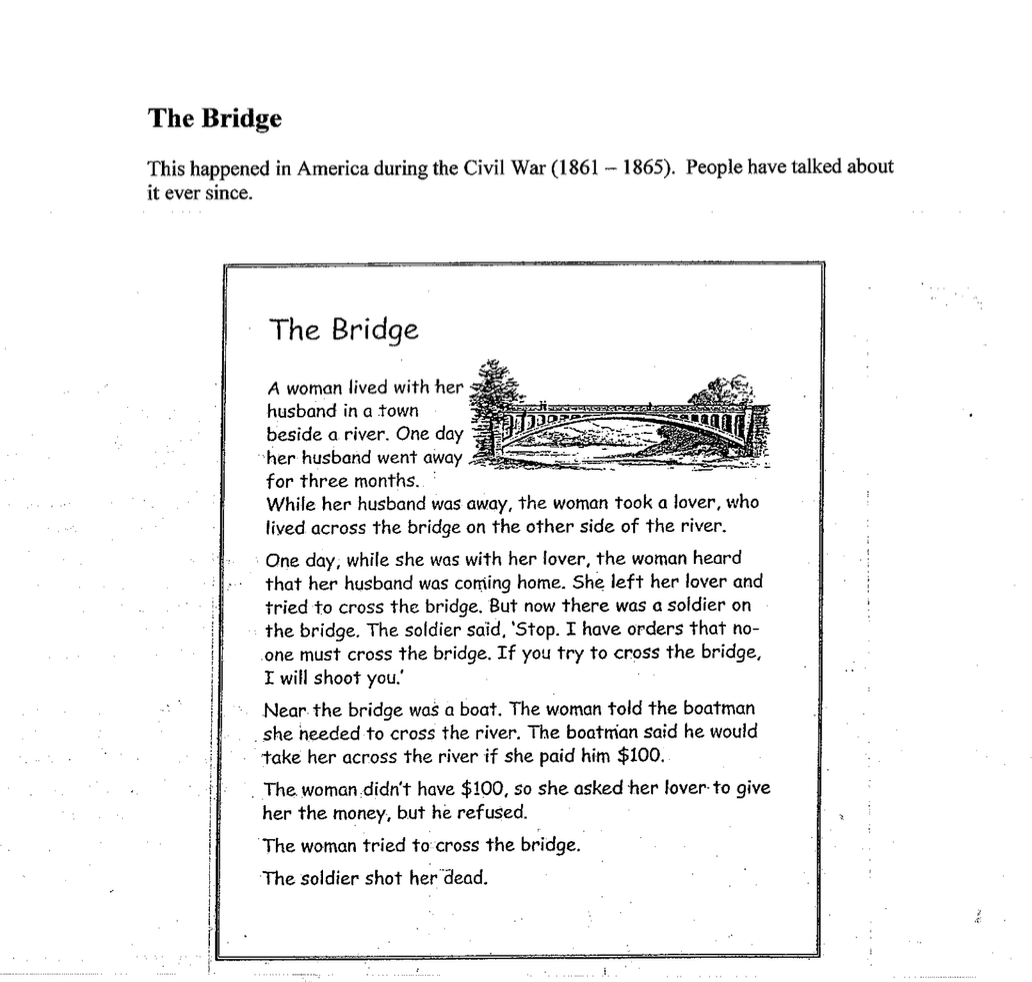
One can see how this sequence prepares pupils for the demand of cognitive conflict in our KS3 lesson The Bridge. The lesson uses a short narrative to explore the characters’ moral responsibility for events, establishes the concept of a fable, before asking the students to consider the importance of characters’ motives. You can review the lesson plan at: https://www.letsthinkinenglish.org/sample-lessons/

The lesson sequence starts with concrete preparation as pupils clarify what a civil war is and who the America Civil War was between. This is not something pupils think hard about as they either know or don’t know. If a pupil knows they are invited to explain to the class, if not the teacher explains. Next pupils read the text:

When we want pupils to think hard we need clarity as the Great Teaching Toolkit highlights in the second section:

The task pupils undertake individually at the start of social construction is to rank the five characters in terms of who they think is most to least responsible for the woman’s death. This is a challenging task; teachers who undertake the same task come to different conclusions and have differing reasons for their order. To support pupils, we need to clarify information that may seem obvious but is crucial: who are the five characters in the text. If we recall the ranges of cognition the CSMS project found, then after reading this text some pupils will immediately be able to recall all five characters while others will struggle. Trying to recall the five characters is an unnecessary distraction from their thinking which can be avoided by recapping and providing them with a sheet with the characters’ listed.


The benefits of thinking hard together

In the social construction phase of the lesson pupils develop their understanding of the text. In this instance, they consider individually who was responsible for the woman’s death, working from most responsible to least responsible. This task requires pupils to think hard but it is a manageable difficulty as pupils have impulsive reactions to the text: “The woman is most responsible because she cheated”, “The husband is the least responsible as he wasn’t there.”

However, pupils are required to think harder when they are asked to share their responses with their peers and come to an agreed order. Now individual thoughts are exposed to scrutiny and must be justified. Pupils have to make their thinking visible and accessible to another and may have to defend their choices. Justification is best found in the text so pupils may still argue the woman is to blame because she cheated but may also identify the importance of “took a lover” as it indicates she instigated the affair. They might support their opinion the lover is responsible as “he refused” to give her the money with “refused” indicating he had the money and therefore a choice. Pupils understanding is developed further and they are provoked to re-evaluate once more as they share their agreed order with other groups in whole class feedback. Can their order stand up to the scrutiny of the whole class? Can they recognise the merits of alternative ways of considering responsibility? Is their knowledge flexible? Will they adapt based on new insights? Is it durable? Can they justify their order when faced with an alternative viewpoint?


Teachers’ support in focusing thinking

The teacher supports the pupils in these exchanges by highlighting important details the class might miss: “Was $100 a lot of money in the 1860s? Does that influence your order?” or challenging pupils to provide more robust reasoning: “Your group are arguing the solider is not the most responsible despite shooting the woman as his actions might be necessary. Can you explain further?”. The teacher also supports the pupils to ensure they are not distracted by unfounded speculation or misconceptions stepping in when necessary: “Is there anything in the text to suggest the husband and the solider are the same person? No? I agree so let’s stick to the text” or “Do you think it is likely that the woman would be allowed to swim across the river if she’s not allowed to cross it by foot?”. The teacher must support the pupils to keep their attention focused on aspects and enquiries regarding the text that are most fruitful without constraining their personal responses. The teacher supports pupils to think by as the Great Teaching Toolkit suggests: “using questions and dialogue to promote elaboration and connected, flexible thinking among learners.” but the teacher’s feedback also supports pupils to focus their attention on relevant details or possibilities.

Going beyond assimilation to accommodation

The social construction stage encourages pupils to think hard but the demand is typically manageable for individuals. All pupils can attempt to rank the characters although there is variance in the levels of justification. Typically, there is a convergence of thoughts with a common Year 7 order for responsibility: The woman, the soldier, the lover, the boatman and the husband. While the ranking activity in The Bridge allows for various possibilities which encourage pupils to think hard usually a class consensus is agreed after whole-class feedback.

For cognitive conflict the demand is increased as pupils must be presented with something puzzling or discordant with their initial impressions. The challenge is raised as they are asked to have empathy with the characters and consider good or acceptable reasons for the characters’ actions.  Pupils are encouraged to review their first impulsive conclusions and work through the challenge of considering the opposite standpoint. When considering why the woman might make her choices pupils start to consider the time the text is set and its relevance.

Thinking moves beyond the impulsive and passionate responses that are typical of the ranking activity to a more deliberate and difficult consideration as they seek to accommodate a new way of reviewing the characters. If individuals were asked to undertake this task it would prove too difficult for many as they struggle to reverse their initial thoughts but working in a small group their zone of proximal development expands as they hear the insights of their peers and grapple with and build upon the ideas shared. Some of the possible motivations and reasons for the woman’s behaviour are listed below and are shared with the class after whole-class feedback as a point of comparison. The list is not exhaustive and there may be other possibilities the class may offer but no one pupil would provide all the possible reasons listed below.


Thinking hard collectively rather than individual responses

The teacher’s role is to control the pace of learning and to support all pupils to appreciate and actively engage with the responses given. Rather than asking: “Do we agree the war might help us to understand why the woman behaved as she did?” we ask more directed questions such as “X suggested we might understand the woman’s behaviour better when we consider the impact of the war. What do you think about that idea?”. The teacher is monitoring the room looking for indications of when the ideas being shared are beyond the understanding of the majority of the class. When this happens, the teacher can invite the pupils to return to their groups to consider their peers’ thoughts and provide time for them to appreciate the points shared. The group provides a safe space when thinking is hard and allows pupils to rehearse and share ideas. When pupils are thinking hard, teachers should consider their feedback carefully including whether or not praise supports the process or not (See blog post: In praise of neutrality). The Great Teaching Toolkit highlights the importance of feedback:

The suggestion is that feedback is largely from teacher to pupil. Yet feedback between pupils is important too and should be developed and fostered slowly building pupil efficacy and interdependence rather than over-reliance on the teacher.


Cycles of thinking: metacognition and conscious awareness

 Let’s Think in English makes pupils consciously aware of their thought processes and supports them to critically evaluate their ideas. Developing awareness of thinking is not merely thinking hard but also reflecting upon the thoughts you have and how they were developed. Once more we can support pupils individually as suggested in the Great Teaching Toolkit:

But there is also merit in considering how as a class we arrive at interpretations and understanding. In The Bridge lesson, after considering good or acceptable reason for the characters’ actions groups are invited to discuss adaptations to the text to make it more entertaining without changing the plot. They consider back stories, narrative perspectives, dialogue etc and discuss where they might add these adaptations to the text and their impact. This is followed by metacognition as pupils reflect upon how their understanding of the text has changed throughout the lesson. Is their ranking still the same now? If so, why? If not, what has changed? When explaining how their ideas evolved, they often reference the input of another pupil as they recall their learning journey. Pupils plan for future learning as they evaluate what they have learnt during the lesson.

Learning and performance and the need for bridging

 When we ask pupils to think hard it is likely performance might diminish in the short term. Learning is a continuum and pupils need support to think hard regularly not as a one-off activity and to revisit their learning. This is implied in the fifth recommendation from the Great Teaching Toolkit:

The Let’s Think in English lessons are taught fortnightly, so pupils are regularly provided with opportunities to think hard and reflect upon their learning. Importantly after the LTE lessons pupils are given opportunities for bridging: applying their learning in another setting. This links back to the idea of durable and flexible knowledge as suggested by the Bjorks. After an LTE lesson, teachers identify opportunities for pupils to build links with their LTE lesson. Following The Bridge lesson this might be comparing the sparse description with a section of a class novel and considering the writer’s contrasting choices. It may be reminding pupils of the process they undertook when deciding who was responsible in The Bridge before they draft an argument on another topic. Thinking needs to be practised but also activated to become fluent and secure. With time, pupils bridge from LTE lessons to other lessons unprompted, suggesting links and parallels.


Thinking hard: Pupil and Teacher

 Philip Adey sounded a note of caution in his paper: “A model for the professional development of teachers of thinking[1]in July 2005:

“As with any approach to the teaching of thinking, the teachers need to have an understanding of the underlying principles and almost always need to re-engineer their classroom methods. I suggest that any approach to the teaching of thinking which offers a ‘quick fix’, or a set of simple tactics that a teacher can follow from printed material alone is underestimating the subtlety of the pedagogy required to enhance students’ thinking. In common with other programmes for teaching thinking, cognitive acceleration requires teachers to inspect their own assumptions about the nature of teaching and learning, and gradually to come to terms with quite new approaches in the classroom.”

As the Great Teaching Toolkit suggested, getting pupils to think hard “… may also be the hardest part of the job to learn.”. As I explained in the blog post: “The Mirror: Effective Professional Development” teachers need to be supported to think hard in order to support their pupils to do the same. Through a commitment to supporting teachers’ learning rather than immediate performance they can develop the knowledge, skills and expertise to support their pupils’ thinking.

References:

[1] Piaget, J., & Cook, M. T. (1952). The origins of intelligence in children. New York, NY: International University Press.

[2] Vygotsky, L. S. (1978). Mind in society: The development of higher psychological processes. Cambridge, MA: Harvard University Press.

[3] Soderstrom, Nicholas & Bjork, Robert. (2015). Learning Versus Performance: An Integrative Review. Perspectives on psychological science : a journal of the Association for Psychological Science. 10. 176-199. 10.1177/1745691615569000.

[4] Adey & Shayer (1994, 97, 2001) Really Raising Standards (Routledge)

[5] Towards a science of science teaching by Michael Shayer and Philip Adey. London: Heine‐mann Educational Books, 1981

[6] Adey, Philip. (2006). A model for the professional development of teachers of thinking. Thinking Skills and Creativity. 1. 49-56. 10.1016/j.tsc.2005.07.002.


Structural prior knowledge and the power of prediction

Structural prior knowledge and the power of prediction

From reviews of effective teaching instruction to insights from neuroscience and cognitive science, there is consensus on the importance of assessing, adding to and linking prior knowledge. This could be summarised as:

New learning needs to be connected to and build upon what you already know.

It can be helpful to “assess” or check students understanding and knowledge while supporting students to fill in any gaps identified.

It is helpful to find out what students know about a topic from their everyday experience and link to that.

In this post I’ll explore the importance of both topical and structural prior knowledge in relation to reading.

Prior knowledge and reading

In reading, prior knowledge refers to the knowledge readers have before studying a text. A key study exploring prior knowledge and reading was: Effect of prior knowledge on good and poor readers’ memory of text by Recht & Leslie, 1988[i].  The researchers asked 7th and 8th graders to read a text about a baseball game. They divided the students into four groups: good readers who were high or low in baseball knowledge, and poor readers who were high or low in baseball knowledge. They found that reading ability contributed less to comprehension success than the students’ levels of knowledge about baseball. Good readers with high prior knowledge did no better than poor readers with high prior knowledge when it came to reading comprehension. As Recht explained:

“Prior knowledge creates a scaffolding for information…. For poor readers, the scaffolding allows them to compensate for their generally inefficient recognition of important ideas.”

Yet Recht and Leslie’s recommendations were more wide ranging than often implied, as the concluding comment of their paper reveals:

“In light of the importance of adequate prior knowledge, strategy instruction and the knowledge base should be equally considered in the design of instruction. “

The importance of knowledge is further supported by the work of Cunningham and Stanovich[ii] who administered a reading test and three measures of general cultural knowledge. They found a high correlation between reading comprehension and the measures of cultural knowledge.

Topical Prior Knowledge.

When prior knowledge is referenced, it is usually topical prior knowledge that is alluded to. Topical prior knowledge relates to the subject or topic being read. This, as we’ve seen, is important. In Let’s Think in English (LTE) there are some lessons where we provide topical prior knowledge before students read the text as the knowledge is vital for understanding and engagement. For example, when students are studying the KS3 LTE lesson exploring Ray Bradbury’s short story “The Flying Machine” we provide further information regarding the Great Wall of China and some images as this is the topical prior knowledge Bradbury would assume his readers to have.  However, Bradbury would not expect a reader to know the themes of the text or have an overview of the plot before they have read the story as has become the vogue in some classrooms.

An intriguing and surprising example of the need for topical prior knowledge arose when we designed an LTE KS1 lesson based on the short film: Boy and his Kite from Unreal Engine. See:  https://www.youtube.com/watch?v=0zjPiGVSnfI

We were interested in exploring the symbolism of the kite and decided to support pupils’ understanding through a series of questions such as:

Will the boy get his kite back?

Is the boy following the kite or is the kite leading the boy?

Young pupils start to recognise symbolism when they understand an object is behaving or being used in an unusual way or as they frequently say it is acting “weird”. However, to our surprise, a small group of pupils did not find the movements of the kite “weird” or unusual in the film as they had no topical prior knowledge of kites.  We addressed this by providing an opportunity for pupils to clarify the function of kites and share their experiences using them. Once more, we could safely assume the director would expect a viewer to have this topical prior knowledge and without it the symbolism of the kite would be missed.

Could it be a helpful when reading narrative texts to ask what essential topical prior knowledge would the writer expect us to have? Admittedly when exploring narrative texts from another era there may be some specific topical prior knowledge students require but the question remains when in a lesson’s sequence is it best to provide this? Yet narrative texts offer a further support to our understanding in the guise of structural prior knowledge.

Structural Prior Knowledge

Structural prior knowledge refers to knowledge of the structures we use to convey information. Many subjects chiefly use expository texts and therefore it is helpful to activate pupils’ structural prior knowledge of the medium; what do we expect of this, how does it convey information to us. However, in English we frequently use narrative texts, and our knowledge of story architecture is the most used of all structural banks.

Gopink et al [iii](1999) summarised nearly thirty years of research:

“Our brains were designed by evolution to develop story representations from sensory input that accurately approximate real things and experience in the world.… let us predict what the world will be like and so act on it effectively. They are nature’s way of solving the problem of knowledge.”

Gopink’s research confirmed stories are a primary way , humans use to interpret the world around them. As children start to verbalise, an awareness of story structure emerges linked to the sequential actions, expectations, goals and motives they experience in daily interactions. As Gopink explains:

“The baby’s computers start out with a specific program for translating the inputs they get into accurate representations of the world and then into story-based predictions and actions”

This emerging awareness of story structure is fortified by exposure to stories throughout childhood, reinforcing the structural knowledge that emerges in early childhood. Young children use stories to explain as they mimic the communication used by their parents. As Johnson[iv] (1987) explained:

“For children, to explain is to tell the right story that is appropriate to the situation, one that has a chance of successfully answering the questions put to them.”

Are you activating structural prior knowledge?

So how to support students to activate structural prior knowledge of narratives? Well, perhaps the most effective way is simply to read widely. By reading more you develop understanding and knowledge of narrative structures and you start to identify patterns between texts.

However, explicitly focusing on and activating pupils’ prior knowledge of textual structures may  help too. One of our Let’s Think in English Year 2 lessons explores Jon Agee’s brilliant picture book “The Wall in the Middle of the Book”. We start the lesson by showing pupils the front cover of the book and asking them to discuss in their groups:

What type of story might this be?

What might we expect the 2 characters to be like?

The questions trigger pupils’ topical prior knowledge through an exploration of the characters on the front cover and where we might have met such character types before. However, pupils frequently respond to the questions posed by outlining a plot involving the ogre and the knight as they base their predictions on familiar story structures. They quickly classify the characters in terms of good and bad (hero and villain) and predict different goals for the characters (the ogre wishes to get over the wall while the knight is keeping him out).  Activating their structural prior knowledge enables students to predict a possible narrative structure they can review as the story develops. This enables greater engagement with the text as pupils consider how their predictions chime or differ from the choices of the writer and why.

As the lesson progresses pupils are provided with an opportunity to review their structural prior knowledge in the light of the story development so far when we pause on the following page and ask:

How do you think the story will end?

Why do you think this?

By this point pupils are reassessing their earlier impression. They’ve noticed the protagonist of the story has a different problem to contend with than the one they predicted earlier, as the water rises and dangerous creatures appear. Pupils’ predictions of how the story will unfold varies: some pupils maintain their earlier prediction that the ogre will eat the knight. However the majority of the class revise their prediction and feel the ogre will prove to be friendly and help the knight. Pupils draw upon their structural prior knowledge when predicting how the ogre might deny our initial expectations, aware of hints of a twist in the tale (see link to Sonnet 130 at KS3 below).They are also plugging into their structural knowledge  when acknowledging  a problem is usually followed by a resolution and how alterations in a character’s arcs challenges our expectations as readers. Many stories and films are structured to challenge our initial expectations of character or stereotypes. See the short animated  film Lucky Dip as an example: https://www.youtube.com/watch?v=oxsBz7cb8Gg By supporting  pupils to be more aware of narrative structure and how it influences their expectation of characters in “The Wall in the Middle of the Book” we are raising their awareness of  redemption arcs that links such diverse characters as: The Grinch, Mr Darcy, Scrooge and  Severus Snape.

Of course, it is not sufficient to merely make predictions; we must encourage pupils to link their structural knowledge to the text they are studying. The explanation and supporting evidence for a prediction is vital. In this lesson, as well as drawing upon their prior knowledge of character and narrative arcs, pupils must refer to the text to evidence their point of view and provide reasonable readings. When arguing the ogre might turn out to be good and help  the knight, pupils draw upon evidence from the story such as: there are hints the knight might be misled in his assumption that the wall is a “good thing” as animals appeared to be trapped and alarmed in the preceding pages, the knight’s  safety is threatened by the rising water and the ogre’s reaction to the mouse doesn’t appear menacing. Pupils activate their structural knowledge when making predictions but check and revise their mental representation with each new narrative text studied.  This is further developed through metacognition towards the end of the lesson when pupils are invited to reconsider their first thoughts on the story and how they have changed throughout the lesson providing an opportunity to adapt and consolidate their mental representation of narrative structure.

Prediction and structural prior knowledge KS3

The interplay between topical and structural knowledge is crucial as illustrated again in a KS3 LTE lesson exploring Shakespeare’s sonnet 130: “My mistress eyes are nothing like the sun”. This LTE lessons start by providing topical prior knowledge on the concept of “mistress” and its meaning in the poet’s time. Shakespeare would presume his readers would understand the term but our students are likely to understand the usual modern meaning of a married man’s female lover rather than the associations of courtly love implied in the sonnet.

We don’t provide further topical prior knowledge until they have finished exploring the sonnet, with the concluding couplet omitted and reached a class consensus on how the speaker feels about his mistress. Typically, students first thoughts are that the speaker dislikes or hates his mistress as he says her breath “reeks”, describes her hair “as wires” and says she is “nothing like the sun”. These are the immediate phrases that dominate their attention. However, once provided with time to consider the poem more closely, share opinions and supported through questioning “Are there any positive comments from the speaker?”, classes start to develop a more nuanced reading. Pupils are drawn to the line: “I love to hear her speak…” which causes a rereading of the poem and a realisation that the speaker’s use of “if” and “some” ensures the portrayal of his mistress is not as explicitly negative as it first seems. By the end of the discussion they suggest the opening line: “My mistress eyes are nothing like the sun” could be positive as it is not wise to stare at sun and it can strain eyes. Pupils begin to wonder whether or not conventional expressions of love are effective or sincere which we return to later in the lessons.

Students’ structural prior knowledge is activated by asking them to consider how Shakespeare may have concluded the sonnet. Students are set the task of creating their own volta before comparing their version to Shakespeare’s. Most students predict the ending will be positive once they’ve considered the ambiguity within the apparent insults but also because they have an expectation that there will be a “twist”. They typically start their own attempts at creating a couplet with a conjunction such as “But”, “However”, “Yet” as their structural prior knowledge comes into play. Activating this structural prior knowledge supports students to understand the final couplet which they can find tricky to comprehend.

Schemas and narrative sequencing

In Let’s Think in English lessons we focus on the schemas or structures of texts: classification, frames of reference, intentions and consequences, symbolism and narrative sequencing. Each lesson seeks to support students’ knowledge of texts making them aware of the underlying structures that underpin them. All the schemas are important when understanding how texts are created but I’d suggest one is particularly helpful to call upon with any age group when seeking to activate structural prior knowledge: narrative sequencing.

In Let’s Think in English we define narrative sequencing: as an awareness of how sequencing and re-sequencing events creates narratives with different purposes and effects.  It involves understanding how manipulating component parts of a narrative creates additional, perhaps multiple, meanings and layers of complexity. Some simple questions to trigger and activate greater awareness of narrative sequencing might include:

What do you expect to happen in this text?

What might the title, illustration or front cover suggest will happen in the text?

What might happen next?

Did the story meet your expectations?

How is your understanding of the story different now you’ve finished it?

What other texts do you know like this?

How is this similar or different to the last text you studied?

Such simple questions awaken structural prior knowledge and over time expand into an exploration of specific narrative devices such as: narrative perspective, flashbacks, foreshadowing, frame stories, cyclical narratives etc.  By the time GCSE classes are exploring narrative sequencing in LTE they not only consider the structure of  Hemingway’s stories from his collection In Our Time, the similarities and differences between them but they are also challenged to consider the possible sequence of the stories in the collection and whether or not the order of the stories matters.

In order to undertake such a task, pupils must, over time, develop an awareness of structural knowledge across many stories. The sequencing activities we explore in lessons like the Year 2 “The Wall in the Middle of the Book” provides a foundation for more nuanced awareness of complex texts as children progress through their study of English. Structural prior knowledge is a something we can draw upon from a young age by asking pupils to consider their expectations of a text and then review why it conforms or denies them.  Prediction provides pupils with a mental palimpsest and engages them in consideration of how a text are created. Asking pupils to consider what a writer might do next and then review their actual choices activates and strengthens their structural prior knowledge which can be reviewed with each new text they meet.


[i] Recht, D. R., & Leslie, L. (1988). Effect of prior knowledge on good and poor readers’ memory of text. Journal of Educational Psychology, 80(1), 16–20.


[ii] Cunningham, A. E. & Stanovich, K. E. (1997). Early reading acquisition and its relation to reading experience and ability 10 years later. Developmental Psychology, 33, 934-945.

[iii] Gopnik, A., et al. The Scientist in the Crib. New York: Harper Perennial, 1999.

[iv] Johnson, M. The Body in the Mind. Chicago, IL: University of Chicago Press, 1987.