
Lesson One in a Special School
Reasoning About Intentions and Consequences: Lesson One in a special school.
Introduction
One of the central aims of Let’s Think in English (LTE) is to help students develop deeper reasoning about texts. Rather than focusing primarily on comprehension or retrieval, LTE lessons encourage students to explore ideas, test interpretations, and consider alternative perspectives through structured classroom dialogue.
This blog reflects on teaching the LTE lesson The Black Hole with a class of fourteen students in a special school.
Special School: The Class
This class was a KS4/5 English group, working at Entry Level 2 and ranging from Year 9 to Year 14. The learners form a mixed-ability group of students with special educational needs and disabilities, with a range of learning profiles including autism, attention-related needs, global developmental delay, and speech and language difficulties. Teaching for the group is typically highly structured and supportive, with a strong emphasis on developing communication skills, confidence, and meaningful engagement in learning.
Why LTE Tutors Teach the Lessons
From the beginning of the LTE project, one of our key principles has been: those who design the programme should also teach the lessons themselves.When the lessons were first developed, LTE Laurie Smith and I taught them repeatedly in early draft form. This process was crucial. Teaching the lessons allowed us to refine questions, anticipate students’ responses, and understand how cognitive challenge emerges in practice. As part of our introduction to Let’s Think in English training, when we begin working with a new school, we often offer to model an LTE lesson with students so teachers can observe the structure and dialogue in action.
However, although I had taught hundreds of LTE lessons over the years, I had not recently had the opportunity to teach them regularly with the same class over a sustained period. LTE is designed to work cumulatively. Lessons are usually taught every two weeks, allowing students’ reasoning to develop gradually.
For several years, for my own professional development and to deepen my understanding of how LTE works I have volunteered to teach LTE in different settings across an academic year. However, after providing a twilight session for a special school, I volunteered to teach a sequence of LTE lessons in the setting.
I would record the lessons so that we could the dialogic interactions and enable us to examine specific moments of reasoning within lessons and reflect on how teacher questioning supported students’ thinking. Classroom transcripts are a crucial professional development tool in Let’s Think in English training.
More importantly, recording the lessons created the possibility of tracking how students’ reasoning develops over time. Rather than analysing a single lesson in isolation, we could begin to observe how students’ explanations, interpretations and confidence in discussion changed across the sequence.
The Lesson
I decided to start with a Year 6 lesson based on a short film: The Black Hole. See: https://www.youtube.com/watch?v=ru28bohotWA
I selected this lesson as it is captivating and one that piques interest but also, we opted for a video-based lesson so we reduced the cognitive load of understanding and recalling a text and could focus initially on building the habits of conversational turns and reasoning.
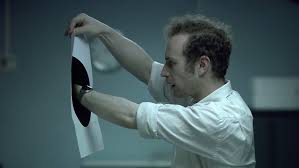
The lesson uses a short film in which an office worker discovers a mysterious “black hole” printed from a photocopier that allows him to reach through solid objects. Initially he uses it to retrieve a cup from a vending machine and steal a chocolate bar. Eventually he attempts to steal money from a safe—but becomes trapped inside.
The narrative creates a compelling puzzle: is the man responsible for his own downfall, or is the black hole itself to blame?
Through structured discussion, students are encouraged to reason about intentions and consequences—a key reasoning pattern within LTE.
We recorded two stages of the lesson:
Students’ predictions on how the film might end
A discussion on who or what is blame for the man’s downfall.
A full transcript is available at the end of this blog post but below are some reflections on what the students were doing within the lesson.
Predicting the Ending
Roughly two-thirds of the way through the film, the video is paused and the students are asked to predict how the story might end. Prediction is a key component of Let’s Think in English. We see prediction as using our prior knowledge to expect or predict the position of a newly introduced piece. With prediction we are inviting students into the process of meaning making but it is not speculative but rather reasoned; the predictions are based on what students have observed, discussed already and the patterns they have identified. See previous blog post on the power of prediction: https://www.letsthinkinenglish.org/what-might-happen-next-internal-models-and-the-power-of-prediction/
The discussion quickly reveals students drawing on different LTE reasoning patterns.
One student suggested the man might escape successfully:
“I think he’s gonna escape work with the money, without being seen.”
Another student introduced the idea of moral consequence:
“Later he gets karma. I think he’s going to get karma.”
This idea sparked further explanation and clarification from another student:
“If you’ve done something bad to someone and later on someone does that to you… that’s karma.”
Here students were already reasoning about cause and consequence, anticipating that the character’s actions might eventually lead to punishment.
A particularly striking contribution came from another student who proposed a detailed alternative explanation of how the film might end:
“Right after he takes the money out of the safe, he’s going to use his body to enter the black hole… then he enters inside the safe but all the money is outside… and there’s no escape.”
This prediction generated further reasoning about how the situation might work physically. When the teacher asked how the paper was held in place, another student immediately recalled an earlier detail:
“It’s stuck with Sellotape.”
This small exchange illustrates an important feature of LTE dialogue: students draw on evidence from the text or film to support or challenge interpretations. While first thoughts are impulsive and emotional, reasoning by contrast is more considered with students being aware they must provide evidence to support their opinions.
Once students had completed their predictions they watched the final moments of the film, with the students reacting immediately. Spontaneous discussion broke out across the room as students compared what they had predicted with what happened. Prediction encourages students to be emotionally and rationally engaged. They are not merely watching the film but rather checking how their mental framework compares with the director’s.
Who is to blame?
The final question in the lesson asked students to decide: Who is responsible for what happens—the man or the black hole? Almost all students initially voted that the man was responsible. Their explanations were revealing.
One student summarised the central idea succinctly:
“Because he’s being greedy.”
Another extended this explanation:
“He’s selfish… he takes one lot out, then he goes for a second lot… it’s greed.”
Here students were identifying a clear progression in the character’s behaviour.
Another student connected the events earlier in the film to the theft from the safe:
“He was acting like a thief… he steals chocolate and then he steals the money.”
This comment demonstrates students reasoning across the entire narrative, identifying patterns in the character’s behaviour. Some students went further, identifying the chain of decisions that led to the outcome. One student observed:
“It’s kind of his fault… he was the one who printed the paper in the first place and it is his fault for walking into the safe.”
This explanation shows students reasoning about agency and responsibility—key aspects of the LTE reasoning pattern of intentions and consequences. However, the discussion did not end there. To extend students’ thinking, the teacher introduced a further puzzle and provocation. If the photocopier produced the black hole without an original, where did it come from?
One student responded confidently:
“The one he had was the original.”
Another student suggested a different possibility:
“When he banged the printer it came out.”
These ideas show students attempting to resolve the narrative inconsistency—a moment of genuine cognitive challenge. Towards the end of the discussion, the teacher revisited an earlier observation about the character’s emotional state. Some viewers interpret the film differently: the man may already be “trapped” in his life before the events of the story. When asked why some people might think this, one student reflected:
“Because he’s working in the office and he looks sad.”
The same student then connected this idea to their earlier observation:
“He’s empty at the start… like he doesn’t like the job. He’s empty. Trapped.”
This moment illustrates how LTE discussion can return to earlier interpretations and deepen them.
Reflections on Teaching the Lesson
In this special school classes’ first Lets’ Think in English lesson several aspects of the pedagogy are emerging:
First, cognitive challenge drives engagement. The puzzle created by the film encouraged students to sustain discussion for an extended period of 40 minutes which is impressive for their first attempt.
Second, dialogue allows reasoning to develop collectively. Students frequently built on one another’s ideas or returned to earlier comments. They are developing their intelligence individually and collectively.
Third, interpretations evolve over time. Many students initially focused on the mysterious black hole itself but gradually shifted towards analysing the character’s decisions.
These shifts are precisely what LTE lessons aim to encourage: students learning to reconsider their interpretations through collaborative reasoning. After the students’ discussions and reflecting upon the lesson transcript, I started to recognise habits the students would need support in developing. I’ll outline my first impressions on the students’ proficiency in discussion in my next blog post.
LTE Special School in Islington: Lesson One, Lesson Transcript
There is a class of 14 students although one leaves for a planned intervention at the point of this transcript. This is their first LTE lessons exploring the Year 6 LTE lesson the Black Hole. https://www.youtube.com/watch?v=8WQXGQYi5kg
At the point of the transcript, students are moving towards the cognitive conflict stage and are approx. two thirds of the way through the film. Students have seen the man taking money from a safe and the film has been paused so they can predict how it might end.
Teacher There is approx. 15 secs of the film left. How do you think it might end?
Student 1 I think he’s gonna escape work with the money, without being see.
Teacher Okay, so you think he’s going to get away , escape work with the money, nobody’s going to find him. Okay? Any other ideas, any other ways of looking at this? What do we think? Go on. You’ve given us lot today. Carry on. Thanks. Okay, one moment we’re going to wait until everyone is ready to listen to you. Thank you.
Student 1 Later he gets karma. I think he’s going to get Karma. But later on, something happens to him, that karma.
Teacher Tell me what does karma means?
Student 2 if you’ve done something bad, some people something if you’ve done something bad to person and later on, someone, some people, do that to you. That’s karma.
Teacher I’ve got you. So, Karma is when, if you do something to someone and something similar happens to you? Okay, tell us a bit more than then.
Student 2 You get good karma, bad karma, bad karma. Okay, so you do something good for somebody. Get good karma depends on what you use. That’s very, very bad. Yeah, so that is very bad.
Teacher Okay, let’s check in. The suggestion here is he’s going to get some bad karma. Hands up if you agree, think something bad will happen to this person at the end. (Majority of students raise their hand in agreement). So you think there’ll be a consequence for his actions? Student 3, tell us, what do you think will happen next? (Student has their hand up to volunteer)
Student 3 Is like, right after he takes the money out of the safe, he’s going to use his body to enter the black hole, and he’s going to enter inside the safe, but all the money is outside of the safe. And then what he enters inside the safe the people and there’s no escape.
Teacher No escape? Why?
Student 3 Because the paper will fall?
Teacher How is the paper been held? Do we know? Did we see?
Student 2 It’s stuck with Sellotape, just a piece of Sellotape.
Teacher So does Student 3’s idea seem possible? ( Nodding and general consensus) .
Student 3 So then there will be no escape. There’s no escape. Yeah, no escape. But unless someone has to use the safe, but, but right now, at this time, you can’t escape, and there’s no way. Just wait till the next day, and then once, once someone goes into the office they use the code, you could be dying there. Is like, right after he takes the money out of the safe, he’s going to use his body to enter the black hole, and he’s going to enter inside the safe, but all the money is outside of the safe. And then what he enters inside the safe the people and there’s no escape.
Teacher That’s a bit like your bad karma idea Student 1? ,
Student 1 Yes it is bad karma, the paper will probably rip. The paper probably rips.
Teacher Ok shall we watch the end of the film? We’ll consider some more questions afterwards. Students watch film. Upon conclusion they burst into impromptu conversation about the events.
Teacher I’m not sure if you’ve realised but you’ve been discussing this film for about 40 minutes. For your first LTE lessons that’s impressive.. I’ve got one last question. I’m going to let you be then, cause you’ve done so well. You’ve thought hard. I’ll give you 2 options, and I’d like you to closer your eyes and put your hands up for which option you think is best. The questions is about, who do you think is to blame for what happens? Listen and think about the two options before raising your hands. Okay, do you think it’s the man is to blame for what happens, or do you think is the black hole that’s to blame? I’m giving you 30 secs thinking time. If you think it’s the man that’s to blame, put your hands up? (Nearly all students put their hand up) If you think it’s the black hole that’s to blame put your hands up. (One student indicates shakes their hand sideways to suggest they are in between). Open your eyes. So, most of you think it’s the man fault. , Have a quick chat in your groups. Students discuss in their small groups for approx. 2 mins.
Teacher Student 4 What do you and your group think?
Student 4 Because he’s being greedy. (Student 4’s first contribution to whole class feedback in the lesson).
Teacher You think the man is to blame because he’s greedy. (Student 4 nods) You think it’s his greed that leads into it?
Student Yes.
Teacher Okay. Anything else anybody wants to add anything?
Student 5 He’s selfish like he wants more money, like this, enough money. He takes one lot out, then he goes for a second lot. He goes right to the back. it’s greed.
Teacher Thank you. it sounds like you got similar ideas to Student 4, greedy, being selfish. Anything else?
Student 3 He was acting like a thief. Because what? So what you can see from this video, he was stealing some chocolate bars from the vending machine. So, so, so that’s how you know that he, he, he is the thief, because he, he steals chocolate, and then he goes on steal the money, doesn’t he sort of takes more and more things.
Teacher Thank you. Anything else anybody wants to say? Okay, last one. Thank you for your contributions.
Student 6 It’s kind of his fault for that? I mean, he was the one who printed the paper in the first place and it is his fault for walking into the safe to get himself stuck?
Teacher Is he stuck in the safe?
Student 1 Yeah, here and tapping at the end, you could hear him inside.
Teacher I wonder what you think about something many classes say to me when considering this film. Remember, when he finds the black hole in the photocopier? You know how photocopies normally work? You put an original down and it makes a copy, But in this film,, remember, the man doesn’t put anything down. He opens it the photocopier, he found the black hole and there doesn’t appear to be an original.. and the man looked puzzled. If the black hole just appeared, do you still think it’s totally his fault?
Student 2 Yeah, the one he had was the original.
Teacher But where did it come from then?
Student 7 This is original, the printer. He banged it, it came out. When he banged it, it came out.
teacher Some students when they watch this film say the man is not trapped at the end of the film when he enters the safe but he’s trapped all the time. Right from the start of the film. , Why might some people think he’s always trapped right from the beginning of the film?,
Student 1 Because I mean his work in the office and he’s trapped and looks sad.,
Teacher Do you remember at the start of the lesson and you said he was empty, his eyes were empty?
Student 1 Yeah he’s empty at the start of the film, like he was empty and he not like the job. Don’t like the job. He’s empty. Trapped. Empty.
Teacher I think we’ll stop for now. Really well done. I really enjoyed listening and. talking to you. Something we’re going to work on for next time is in your groups, is that everybody gets a turn to talk. I think you can do it. It’s no pressure. If you’re not ready, to speak yet it’s okay. You’ve all contributed today in different ways. Thank you.
