Skip to content

Understanding why and how schools commit to the ‘hard case’ of Let’s Think in English

Raising standards for all through challenge: understanding why and how schools commit to the ‘hard case’ of Let’s Think in English

Abstract

Teaching for the development of students’ thinking through a Cognitive Acceleration programme like Let’s Think in English has the potential to significantly raise standards, particularly for lower and lower-middle attainers, in whole class, mixed attainment settings.
Predictably it is no easy win. The requirement for teachers to re-engineer aspects of classroom pedagogy through a sustained, theoretical and challenging professional development programme needs focus and commitment from teachers and school leaders over several years. This multiple case study was conducted to better understand why both primary and secondary schools are choosing the ’hard case’ of Let’s Think, what supports
them through initial implementation and leads them to sustain the challenge. Findings suggest that when the programme takes hold, it is precisely because of the effects of teachers and students working through collaborative challenge not in spite of this.

Keywords: Cognitive Acceleration; Professional Development; Intervention; Case Study;Pedagogy
Authors: Leah Crawford, Laurie Smith, Michael Walsh,

To read the full paper click LTCS draft at 16.05.23 (1)

Thinking hard or Supportive Challenge

EBE Great Teaching Evidence Review

 In June 2020 Evidence Based Education published their Great Teaching Toolkit. It provided evidence-based insights and focused on areas of practice with potential to improve student learning and outcomes.

The review identified four priorities for teachers who want to help their student learn more:

  1.   Understand the content they are teaching and how it is learnt
    2. Create a supportive environment for learning
    3. Manage the classroom to maximise the opportunity to learn
    4. Present content, activities and interactions that activate their students’ thinking

We know activating students’ thinking is crucial despite the term “thinking” appearing to be purposely avoided in Ofsted’s Inspection framework while “knowledge” is mentioned eight times.  However, the EBE Great Teaching Evidence Review is unequivocal on the importance of thinking hard stating:

“In many ways, Dimension 4 represents the heart of great teaching: getting students to think hard about the material you want them to learn. It may also be the hardest part of the job to learn, …”.


 Bjork’s Desirable Difficulties

The need for students to think hard has become associated with the work of cognitive psychologists Elizabeth and Robert Bjork. They coined the term ‘desirable difficulties’, the concept that there are ways of learning that may feel less effective and lead to more errors during the learning process, but that lead to better performance in the long term. As they explained:

“Conditions of learning that make performance improve rapidly often fail to support long-term retention and transfer, whereas conditions that create challenges and slow the rate of apparent learning often optimize long-term retention and transfer.”  Bjork, E. L., & Bjork, R. A. (2011). Making things hard on yourself, but in a good way: Creating desirable difficulties to enhance learning.

Many aspects of the Bjorks’ work are being used in classrooms such as interleaving, spacing and retrieval practice.  etc However a less well-known aspect of their work is the generation effect. The generation effect refers to the long- term benefit of generating an answer, solution, or procedure versus being presented that answer, solution, or procedure. The Bjorks’ argue:

“Basically, any time that you, as a learner, look up an answer or have somebody tell or show you something that you could, drawing on current cues and your past knowledge, generate instead, you rob yourself of a powerful learning opportunity.”.


Piaget: assimilation and accommodation

 Advances in cognitive science have often been seen as challenging earlier theories of learning from Piaget and Vygotsky, yet there is greater synergy than many suggest. The Bjorks’ desirable difficulties echoes aspects of Piaget’s ideas. Piaget through his work on cognitive development introduced the idea of schema. He described schema as: “a cohesive, repeatable action sequence possessing component actions that are tightly interconnected and governed by a core meaning” (Piaget,1952, p. 7) [1]. In developing schema Piaget identified two processes: assimilation and accommodation.

Assimilation is the process by which new knowledge is placed into existing knowledge schemas. For example, pupils may expect poems to rhyme so when they encounter a rhyming poem, they assimilate it in their existing schema as it fits. Accommodation by contrast is the process when existing knowledge has to be adapted to new knowledge. For example, students meet a poem for the first time that doesn’t rhyme and have to draw upon other features to classify the text. Accommodation creates an imbalance, demanding that we think hard as new information does not seamlessly integrate with existing mental schema. As schemas are challenged students have a sense of disequilibrium before accommodation takes place and equilibrium is restored. The key is to seek productive challenges evoking a state of disequilibrium but can be reconciled and assimilated with time.


Vygotsky: Zone of Proximal Development and More Knowledgeable Other

 Similarly, in the Bjorks’ work we can see the trace of “zone of proximal development,” (zpd) a concept first proposed in the 1930s by the Russian psychologist Lev Vygotsky. Vygotsky defined the zpd as “the distance between the actual developmental level as determined by individual problem solving and the level of potential development as determined through problem solving under adult guidance or in collaboration with more capable peers” (Vygotsky, 1978, p. 86) [2]. Zones of proximal development have upper and lower boundaries. If we push students to think beyond the upper limit of their zone of proximal development, they are likely to experience frustration and disengagement. However, teach them below the lower limit and it is unlikely they will think hard. The challenge is to find the sweet spot, but this is complicated when you have a class of 30 students who may all have a different ZPD; we will return to ways of approaching this challenge later.

Learning versus performance and poor proxies for learning

In their paper “Learning versus Performance[3], Nicholas C. Soderstrom and Robert A. Bjork clarify the distinction between the two. Performance is “what can be observed and measured during instruction or training”. Learning, by contrast, can take place after performance but also improvements in performance can fail to yield significant learning. Furthermore:

“performance is often fleeting and, consequently, a highly imperfect index of learning does not appear to be appreciated by learners or instructors who frequently misinterpret short-term performance as a guide to long-term learning.”

A high performing class may not be an environment where learning is sticking. This recalls Professor Robert Coe’s Poor Proxies for learning from his 2013 paper ‘Improving Education: A Triumph of Hope Over Experience’and how we might confuse learning with the veneer of performance:
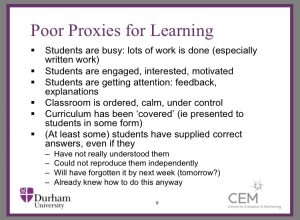
It’s worth pointing out the above proxies may be desirable and can lead to learning. Who doesn’t want engaged, interested and motivated students? However, there is no guarantee that engaged students are learning rather than performing. We can envisage a situation where students are completing lots of written work but are not being challenged so learning doesn’t stick but is washed away.  Coe claims: “Learning happens when people have to think hard” while at the same time recognising the statement is “over-simplistic, vague…”. While Soderstrom and Bjork claim: “Conditions that induce the most errors during acquisition are often the very conditions that lead to the most learning!” One can envisage why a class displaying some of poor proxies for learning might reassure whereas a class committing errors could be misjudged in the moment.


CASE: long and far transfer

 If we accept the distinction between learning and performance, then Soderstrom and R Bjork claim:

“The major goal of instruction—whether in the classroom or in the field—is, or at least should be, to equip the learner with the type of knowledge or skills that are durable (i.e., capable of sustaining long periods of disuse) and flexible (i.e., capable of being applied in different contexts) “.

The need for durability recalls Sweller’s CLT and has become the bedrock of Ofsted’s Inspection Framework which claims:

“Learning can be defined as an alteration in long-term memory. If nothing has altered in long-term memory, nothing has been learned.”.

 Sonderstrom and Bjork’s goal is more subtle with the inclusion of durable and flexible skills and knowledge. What is the goal of knowledge? Knowledge can be a goal in itself, but we also need to develop a relationship with the knowledge we acquire. Can we evaluate the knowledge we have? Is it flexible and can we apply it in different moments, settings and situations? Are we willing to review and reflect upon our knowledge? Sonderstrom and Bjork seem to suggest we should seek educational programmes that are durable with results that are long lasting and flexible so they can be applied in different contexts. It just so happens that such a programme exists.

The ‘Cognitive acceleration’ programmes (CA) were developed by Michael Shayer and Philip Adey at King’s College London.  Cognitive acceleration would evolve over time and become known as Let’s Think www.letsthink.org.uk The aim of the CA programmes was the promotion of higher-level thinking in students. Research carried out over 25 years at King’s College London demonstrated students who experienced a (CA) programme scored higher than matched control groups:

  • on measures of cognitive development immediately at the end of the programme and subsequently;
  • in the subject matter of the programme (e.g. science, maths) up to three years after the end of the programme;
  • also, in subjects remote from the subject context up to three years after the end of the programme. For example, students who followed Let’s Think over two years in a science context when they were 12-13 years old, went on to score significantly higher grades in an English examination taken when they were 16.

CASE has been proved to raise students’ attainment significantly in at least 20 international trials – see Let’s Think in Science (CASE) efficacy

CASE lessons had a learning sequence called the pillars.


Central to the pillars was the concept of cognitive conflict. Shayer and Adey[1] defined cognitive conflict as:

“The term used to describe an event or observation which the student finds puzzling and discordant with previous experience or understanding. All perceptions are interpreted through the learners’ present conceptual framework. Where conceptualisation fails to make sense of an experience, cognitive conflict can lead to constructive mental work by students to accommodate their conceptual framework to the new type of thinking necessary.”

Conflict needed to be carefully judged by the teacher or curriculum developer to be within a context which is somewhat familiar to the student and while making a real cognitive demand on the student, not be so far ahead as to be incomprehensible.

The Concepts in Secondary Mathematics and Science Survey

 When considering how we support pupils to think hard we need to consider their present level of understanding of a particular topic. The Concepts in Secondary Mathematics and Science Project (CSMS) was established in (1974-80) and looked at the problems involved in educating the whole ability range of students in comprehensive schools.  Surveying 14000 students from 45 schools it found:


  • In the population as a whole, fewer than 30 percent of 16 year-olds were showing the use of early formal operations.
  • The range of thinking within any one age group was far wider than had been previously realised. The CSMS data showed that there is likely a 12 year gap between the most able and least able children in the first year of secondary education. In mixed ability schools, the most able 12 years olds were operating at the level of average 18 years olds and the least able at the level of average 6 years-olds.

In Towards a Science of Science Teaching [2],  Shayer and Adey explained the methods and results of the research programme. It gave an account of testing instruments (Science Reasoning Tasks) which teachers could use to assess the cognitive levels of their students and gave details of a curriculum analysis taxonomy for analysing the level of difficulty of any science activity. The book showed that there were significant areas of mismatch in terms of the cognitive demands of the curricula.

Towards a Science of Science Teaching highlighted the importance of identifying the emerging thinking schemas needed for successful learning, reviewing pupils understanding of the schema at different stages of development and considering how best to prepare them for new learning in the identified schemas.


Let’s Think in English: thinking hard with support


What should pupils think hard about in English?

Let’s Think in English (LTE) was closely modelled on Shayer and Adey’s Cognitive Acceleration in Science Education (CASE). The LTE lessons stimulate schemas or reasoning patterns which underpin deeper understanding of texts. LTE seeks to develop five forms of reasoning with pupils:

Classification: exploring genre, text type, character type, form.

Frames or reference: considering perspectives, contexts and re-presenting texts for different purposes.

Symbolic representation: identifying and understanding the shift from literal to figurative in texts, character, setting or considering objects that stand for more than it is.

Intentions and consequences: the methods, techniques, and choices a writer has made to achieve their intent.

Narrative sequencing: considering the chronology, pace, emphasis, narrator of a text.

In LTE we seek to develop pupils’ ability to reason in English. Reasoning is identifying patterns in new sources of information and we seek to develop pupils’ ability to apply the five schemas to texts. Over time pupils see links between texts as they become increasing aware of the structures of the text as well as the content. Once they become aware of how experts – accomplished writers – structure texts they can start to incorporate and imitate these structures into their own writing.

By identifying the underpinning schemas that support understanding of texts we can start to identify progression within them and evaluate pupils’ understanding at different stages of development. If we take narrative sequencing we would expect a year 2 pupil to be able to sequence events into a chronological order. They would have an awareness of narrative structure and expectations of a beginning, middle and end to a story. As pupils progress into upper KS2 they can order a set of events along a variety of relevant criteria including non-chronological and may question the order of events if there is inconsistency. The awareness of plot may have progressed towards understandings of models of narrative like the story mountain and they should have greater awareness of complex narrative techniques like flashbacks or foreshadowing. Whereas by KS3 they may be able to provide an account of the implicit order of the events in a text and recognise the merits of the narrative sequence selected while appreciating or evaluating alternatives.

Identifying the schemas to be developed, considering progression within them and appreciating pupils’ typical stages of development ensures pupils’ thinking is directed appropriately and teachers can design suitable challenges for their classes. The Great Teaching Toolkit recognises the importance of this under its first sub-heading:

Structuring and preparing to think hard

Structuring is an important concept when considering how we support pupils to think hard. Pupils require a platform of understanding before they can embark on a difficult challenge. In Let’s Think in English pupils develop understanding of the texts through two important stages: concrete preparation and social construction before they undertake the most challenging stage of the lesson: cognitive conflict.

One can see how this sequence prepares pupils for the demand of cognitive conflict in our KS3 lesson The Bridge. The lesson uses a short narrative to explore the characters’ moral responsibility for events, establishes the concept of a fable, before asking the students to consider the importance of characters’ motives. You can review the lesson plan at: https://www.letsthinkinenglish.org/sample-lessons/

The lesson sequence starts with concrete preparation as pupils clarify what a civil war is and who the America Civil War was between. This is not something pupils think hard about as they either know or don’t know. If a pupil knows they are invited to explain to the class, if not the teacher explains. Next pupils read the text:

When we want pupils to think hard we need clarity as the Great Teaching Toolkit highlights in the second section:
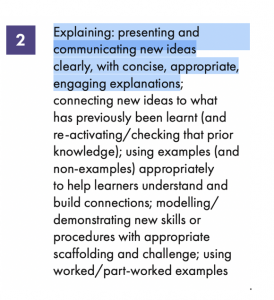
The task pupils undertake individually at the start of social construction is to rank the five characters in terms of who they think is most to least responsible for the woman’s death. This is a challenging task; teachers who undertake the same task come to different conclusions and have differing reasons for their order. To support pupils, we need to clarify information that may seem obvious but is crucial: who are the five characters in the text. If we recall the ranges of cognition the CSMS project found, then after reading this text some pupils will immediately be able to recall all five characters while others will struggle. Trying to recall the five characters is an unnecessary distraction from their thinking which can be avoided by recapping and providing them with a sheet with the characters’ listed.


The benefits of thinking hard together

In the social construction phase of the lesson pupils develop their understanding of the text. In this instance, they consider individually who was responsible for the woman’s death, working from most responsible to least responsible. This task requires pupils to think hard but it is a manageable difficulty as pupils have impulsive reactions to the text: “The woman is most responsible because she cheated”, “The husband is the least responsible as he wasn’t there.”

However, pupils are required to think harder when they are asked to share their responses with their peers and come to an agreed order. Now individual thoughts are exposed to scrutiny and must be justified. Pupils have to make their thinking visible and accessible to another and may have to defend their choices. Justification is best found in the text so pupils may still argue the woman is to blame because she cheated but may also identify the importance of “took a lover” as it indicates she instigated the affair. They might support their opinion the lover is responsible as “he refused” to give her the money with “refused” indicating he had the money and therefore a choice. Pupils understanding is developed further and they are provoked to re-evaluate once more as they share their agreed order with other groups in whole class feedback. Can their order stand up to the scrutiny of the whole class? Can they recognise the merits of alternative ways of considering responsibility? Is their knowledge flexible? Will they adapt based on new insights? Is it durable? Can they justify their order when faced with an alternative viewpoint?


Teachers’ support in focusing thinking

The teacher supports the pupils in these exchanges by highlighting important details the class might miss: “Was $100 a lot of money in the 1860s? Does that influence your order?” or challenging pupils to provide more robust reasoning: “Your group are arguing the solider is not the most responsible despite shooting the woman as his actions might be necessary. Can you explain further?”. The teacher also supports the pupils to ensure they are not distracted by unfounded speculation or misconceptions stepping in when necessary: “Is there anything in the text to suggest the husband and the solider are the same person? No? I agree so let’s stick to the text” or “Do you think it is likely that the woman would be allowed to swim across the river if she’s not allowed to cross it by foot?”. The teacher must support the pupils to keep their attention focused on aspects and enquiries regarding the text that are most fruitful without constraining their personal responses. The teacher supports pupils to think by as the Great Teaching Toolkit suggests: “using questions and dialogue to promote elaboration and connected, flexible thinking among learners.” but the teacher’s feedback also supports pupils to focus their attention on relevant details or possibilities.

Going beyond assimilation to accommodation

The social construction stage encourages pupils to think hard but the demand is typically manageable for individuals. All pupils can attempt to rank the characters although there is variance in the levels of justification. Typically, there is a convergence of thoughts with a common Year 7 order for responsibility: The woman, the soldier, the lover, the boatman and the husband. While the ranking activity in The Bridge allows for various possibilities which encourage pupils to think hard usually a class consensus is agreed after whole-class feedback.

For cognitive conflict the demand is increased as pupils must be presented with something puzzling or discordant with their initial impressions. The challenge is raised as they are asked to have empathy with the characters and consider good or acceptable reasons for the characters’ actions.  Pupils are encouraged to review their first impulsive conclusions and work through the challenge of considering the opposite standpoint. When considering why the woman might make her choices pupils start to consider the time the text is set and its relevance.

Thinking moves beyond the impulsive and passionate responses that are typical of the ranking activity to a more deliberate and difficult consideration as they seek to accommodate a new way of reviewing the characters. If individuals were asked to undertake this task it would prove too difficult for many as they struggle to reverse their initial thoughts but working in a small group their zone of proximal development expands as they hear the insights of their peers and grapple with and build upon the ideas shared. Some of the possible motivations and reasons for the woman’s behaviour are listed below and are shared with the class after whole-class feedback as a point of comparison. The list is not exhaustive and there may be other possibilities the class may offer but no one pupil would provide all the possible reasons listed below.

 

Thinking hard collectively rather than individual responses

The teacher’s role is to control the pace of learning and to support all pupils to appreciate and actively engage with the responses given. Rather than asking: “Do we agree the war might help us to understand why the woman behaved as she did?” we ask more directed questions such as “X suggested we might understand the woman’s behaviour better when we consider the impact of the war. What do you think about that idea?”. The teacher is monitoring the room looking for indications of when the ideas being shared are beyond the understanding of the majority of the class. When this happens, the teacher can invite the pupils to return to their groups to consider their peers’ thoughts and provide time for them to appreciate the points shared. The group provides a safe space when thinking is hard and allows pupils to rehearse and share ideas. When pupils are thinking hard, teachers should consider their feedback carefully including whether or not praise supports the process or not (See blog post: In praise of neutrality). The Great Teaching Toolkit highlights the importance of feedback:

The suggestion is that feedback is largely from teacher to pupil. Yet feedback between pupils is important too and should be developed and fostered slowly building pupil efficacy and interdependence rather than over-reliance on the teacher.


Cycles of thinking: metacognition and conscious awareness

 Let’s Think in English makes pupils consciously aware of their thought processes and supports them to critically evaluate their ideas. Developing awareness of thinking is not merely thinking hard but also reflecting upon the thoughts you have and how they were developed. Once more we can support pupils individually as suggested in the Great Teaching Toolkit:

But there is also merit in considering how as a class we arrive at interpretations and understanding. In The Bridge lesson, after considering good or acceptable reason for the characters’ actions groups are invited to discuss adaptations to the text to make it more entertaining without changing the plot. They consider back stories, narrative perspectives, dialogue etc and discuss where they might add these adaptations to the text and their impact. This is followed by metacognition as pupils reflect upon how their understanding of the text has changed throughout the lesson. Is their ranking still the same now? If so, why? If not, what has changed? When explaining how their ideas evolved, they often reference the input of another pupil as they recall their learning journey. Pupils plan for future learning as they evaluate what they have learnt during the lesson.

Learning and performance and the need for bridging

 When we ask pupils to think hard it is likely performance might diminish in the short term. Learning is a continuum and pupils need support to think hard regularly not as a one-off activity and to revisit their learning. This is implied in the fifth recommendation from the Great Teaching Toolkit:

The Let’s Think in English lessons are taught fortnightly, so pupils are regularly provided with opportunities to think hard and reflect upon their learning. Importantly after the LTE lessons pupils are given opportunities for bridging: applying their learning in another setting. This links back to the idea of durable and flexible knowledge as suggested by the Bjorks. After an LTE lesson, teachers identify opportunities for pupils to build links with their LTE lesson. Following The Bridge lesson this might be comparing the sparse description with a section of a class novel and considering the writer’s contrasting choices. It may be reminding pupils of the process they undertook when deciding who was responsible in The Bridge before they draft an argument on another topic. Thinking needs to be practised but also activated to become fluent and secure. With time, pupils bridge from LTE lessons to other lessons unprompted, suggesting links and parallels.


Thinking hard: Pupil and Teacher

 Philip Adey sounded a note of caution in his paper: “A model for the professional development of teachers of thinking[1]in July 2005:

“As with any approach to the teaching of thinking, the teachers need to have an understanding of the underlying principles and almost always need to re-engineer their classroom methods. I suggest that any approach to the teaching of thinking which offers a ‘quick fix’, or a set of simple tactics that a teacher can follow from printed material alone is underestimating the subtlety of the pedagogy required to enhance students’ thinking. In common with other programmes for teaching thinking, cognitive acceleration requires teachers to inspect their own assumptions about the nature of teaching and learning, and gradually to come to terms with quite new approaches in the classroom.”

As the Great Teaching Toolkit suggested, getting pupils to think hard “… may also be the hardest part of the job to learn.”. As I explained in the blog post: “The Mirror: Effective Professional Development” teachers need to be supported to think hard in order to support their pupils to do the same. Through a commitment to supporting teachers’ learning rather than immediate performance they can develop the knowledge, skills and expertise to support their pupils’ thinking.

References:

[1] Piaget, J., & Cook, M. T. (1952). The origins of intelligence in children. New York, NY: International University Press.

[2] Vygotsky, L. S. (1978). Mind in society: The development of higher psychological processes. Cambridge, MA: Harvard University Press.

[3] Soderstrom, Nicholas & Bjork, Robert. (2015). Learning Versus Performance: An Integrative Review. Perspectives on psychological science : a journal of the Association for Psychological Science. 10. 176-199. 10.1177/1745691615569000.

[4] Adey & Shayer (1994, 97, 2001) Really Raising Standards (Routledge)

[5] Towards a science of science teaching by Michael Shayer and Philip Adey. London: Heine‐mann Educational Books, 1981

[6] Adey, Philip. (2006). A model for the professional development of teachers of thinking. Thinking Skills and Creativity. 1. 49-56. 10.1016/j.tsc.2005.07.002.



The Mirror: Effective Professional Development

The argument for continuing professional development

Education Policy Institute (EPI) undertook a detailed review of the evidence on the impact of teacher professional development. The report examined 52 randomised controlled trials evaluating teacher development programmes, in order to establish their impact on pupil and teacher outcomes.  Unsurprisingly, they found continuing professional development (CPD) can play a crucial role in improving teaching quality.

The report summarises the key findings of the impact on pupils as:

  • High-quality CPD for teachers has a significant effect on pupils’ learning outcomes. CPD programmes have the potential to close the gap between beginner and more experienced teachers: the impact of CPD on pupil outcomes (effect size 0.09) compares to the impact of having a teacher with ten years’ experience rather than a new graduate (0.11). CPD also has similar attainment effects to those generated by large, structural reforms to the school system (0.1).
  • Evidence suggests that quality CPD has a greater effect on pupil attainment than other interventions schools may consider, such as implementing performance-related pay for teachers or lengthening the school day.
  • Teacher CPD may be a cost-effective intervention for improving pupil outcomes: while there are other interventions with a larger impact on pupil attainment, such as one-to-one tutoring (0.28), these programmes are typically far more expensive.
  • CPD programmes generally produce positive responses from teachers, in contrast to other interventions. Large, structural changes to the school system, while as effective at improving pupil outcomes, incur substantial costs in terms of staff turnover and dissatisfaction.

They also reported positive impact on teacher retention as well as improving access to professional development for teachers.

Characteristics of effective professional development

There are a number of informative reports into effective professional development including:

Darling-Hammond, L., Hyler, M. E., Gardner, M. (2017). Effective Teacher Professional Development. Palo Alto, CA: Learning Policy Institute.

https://learningpolicyinstitute.org/product/teacher-prof-dev.

Cordingley, P., Higgins, S., Greany, T., Buckler, N., Coles-Jordan, D., Crisp, B., Saunders, L., Coe, R. Developing Great Teaching: Lessons from the international reviews into effective professional development. Teacher Development Trust. 2015.

https://tdtrust.org/wp-content/uploads/2015/10/DGT-Full-report.pdf

Cordingley, P. and Bell, M., 2012. Understanding what enables high quality professional learning: A report on the research evidence. CUREE

http://www.curee.co.uk/files/publication/%5Bsite-timestamp%5D/CUREE-Report.pdf

What emerges across the reports is a consensus on the key attributes of effective continual professional development which can be summarised as:

  • Collaborative involves staff working together, identifying starting points, sharing evidence about practice and trying out new approaches;
  • Supported by specialist expertise usually drawn from beyond the learning setting.
  • Focused on aspirations for students which provides the moral imperative and shared focus;
  • Sustained over time and rhythmic professional development sustained over weeks or months had substantially more impact on practice benefiting students than shorter engagement;
  • Uses models of effective practice provide teachers with a clear vision of what best practices look like.
  • A shared sense of purpose
  • Pedagogy and subject knowledge are equally important

Professional Development insights from Cognitive acceleration

 The ‘Cognitive acceleration’ programmes (CA) were developed by Michael Shayer and Philip Adey at King’s College London.  Cognitive acceleration would evolve over time and become known as Let’s Think www.letsthink.org.uk The aim of the CA programmes was the promotion of higher-level thinking in students. Research carried out over 25 years at King’s College London demonstrated students who experienced a (CA) programme scored higher than matched control groups:

  • on measures of cognitive development immediately at the end of the programme and subsequently;
  • in the subject matter of the programme (e.g. science, maths) up to three years after the end of the programme;
  • also in subjects remote from the subject context up to three years after the end of the programme. For example, students who followed Let’s Think over two years in a science context when they were 12-13 years old, went on to score significantly higher grades in an English examination taken when they were 16.

CASE has been proved to raise students’ attainment significantly in at least 20 international trials – see Let’s Think in Science (CASE) efficacy

Shayer and Adey both recognised the importance of professional development. As Adey commented in his paper: “A model for the professional development of teachers of thinking”[i] in July 2005:

“(CA)…has a theory base in cognitive psychology, well-described pedagogical features, and sets of materials, which we believe to be teacher friendly. Nevertheless, teaching for cognitive acceleration is not a straightforward process. As with any approach to the teaching of thinking, the teachers need to have an understanding of the underlying principles and almost always need to re-engineer their classroom methods. I suggest that any approach to the teaching of thinking which offers a ‘quick fix’, or a set of simple tactics that a teacher can follow from printed material alone is underestimating the subtlety of the pedagogy required to enhance students’ thinking. In common with other programmes for teaching thinking, cognitive acceleration requires teachers to inspect their own assumptions about the nature of teaching and learning, and gradually to come to terms with quite new approaches in the classroom.”

From his work introducing science curriculum and in-service education programme for science and maths teachers internationally, Adey identified three main implications from the experiences:

  • Changing teaching practice takes a long time. There are no short-cuts or quick fixes, real change in schools takes effort and lasts months if not years.
  • There is no substitute for human interaction in helping teachers to shift their attitudes and beliefs. Discussion along paths which are not pre-set by a “programmed PD” is essential.
  • You must get into schools, if you want to change what happens in schools. A course will have no deep effect if it is limited to sessions run in a university or professional development centre. Demonstrations and coaching in teachers’ classrooms play a critical role.

Adey identified the principles of duration, collaboration, expert support, linked to classroom practice, etc, that subsequent research would confirm. Based on this the professional development programme for CA offered from 1991 was:

  • Sequenced over 2 school years, in parallel with the schools introducing the CASE methods.
  • INSET days were scheduled to introduce the theory and activities, teachers would then try them out lessons in their schools and return to further training days to reflect on the successes and difficulties encountered.
  • The style of the INSET days mirrored the pedagogy of CASE itself. Teachers were provided with challenges which led to social construction as they talked and listened to each other before triggering metacognition as they reflected on how (and why) their own perspectives were changing.
  • Furthermore, most teachers in a department received personal coaching in their own classes, to see how the methods worked with their students.

Let’s Think in English professional development programme

 Background

 Let’s Think in English (LTE) was closely modelled on Shayer and Adey’s Cognitive Acceleration in Science Education (CASE).  King’s College London, where CA had originated, decided to develop a programme for English like those in Science and Maths. This began in 2009 and Laurie Smith and I, supervised by Philip Adey, led the development initially focussed on Years 7 and 8.  Following successful trialling of the LTE Key Stage 3 English lessons, further lessons were developed specifically for GCSE and for Key Stages 1 and 2.

Collaboration

Many of the key features of successful professional development underpinned the evolution of the LTE programme. From the early trials, collaboration between colleagues was central to its development. We never created lessons and merely published them. Instead we would draft, critique, teach and revise LTE lessons before sharing them with the pilot group of teachers. This cycle would resume as the pilot group of teachers undertook the same process providing initial feedback after sampling the lesson, returning to school to teach the lesson in their setting and sharing their thoughts at the next LTE meeting.

Sequenced training

It became clear from the pilot group’s feedback that, as Adey suggested, there were “no quick fixes” and professional development would need to be sequenced over time. We opted for an introductory programme of four training sessions in an academic year. The typical structure of introductory Let’s Think in English training remains:

Session 1: Introductory day reviewing the pedagogy and research behind the programme and a lesson taught by the LTE tutor.

Session 2: Another modelled lesson taught by the LTE tutor or observation of LTE lesson depending on the schools’ preference and a twilight on effective group work and social construction

Session 3: Observation of LTE in classes with the LTE lead and a twilight reviewing the development of higher order thinking and metacognition.
Session 4: Twilight on embedding LTE and planning your own LTE lessons.

The training was designed so the “specialist expertise” (LTE Tutor) would provide regular support but the practitioners have time to develop their own understanding and are empowered to consider how best to apply the research in their setting between sessions.

Modelled Lessons and authenticity

Laurie Smith and I agreed we would always be willing to model the LTE lessons as part of training. Teachers relished the luxury and time to observe their class being taught by someone else and discussing key moments with their colleagues. We were providing teachers with a “model of effective practice” for them to critique. The lessons were never labelled model lessons but rather example lessons designed to provoke discussion and reflection.

Another important component of professional development is authenticity. Time and again teachers would comment how refreshing it was to experience training where the trainer was willing to model the approach in the classroom. Linking with the required “sense of shared purpose” and focus on “student attainment” teachers have to believe in the individual or organisation leading the training. When teachers know you’re willing to teach their classes, that you’ve experienced the process they are embarking on and in all likelihood faced similar challenges, it develops a sense of trust and strengthens the collaboration.

Duration and accountability

 Duration we know is important and the cycle of LTE training is designed so teachers have an opportunity to engage with research, apply it in their classroom and review with peers before reflecting and deciding upon next steps. However, training over time also introduces further important characteristic of continual professional development perhaps implied but not listed in the key features: accountability. I would suggest training over time makes trainers more accountable. When a trainer returns on a cycle to provide professional development, they are accepting a responsibility; a promise to return and work with the school, department or individual to overcome the challenges to successfully embed a programme. We know from Michael Fullan’s work in Leading in a Culture of Change [ii](2007):

“All successful schools experience “implementation dips” as they move forward (Fullan, 2001). The implementation dip is literally a dip in performance and confidence as one encounters an innovation that requires new skills and new understandings.”

 Let’s Think in English is usually very well received by teachers with the vast majority of evaluations ranking the training as excellent. However, there is a rhythm to the training in terms of the responses it provokes in teachers. We expect an implementation dip as theory is applied in the classroom. Indeed, we purposefully make the training challenging so teachers experience the desirable difficulty they will create for their pupils. By returning and supporting colleagues with the implementation dip we are accountable but also engaging in and reinforcing “shared sense of purpose”. Modelling and observing lessons on training connects us to the pupils our work serves to help; they are no longer a mental construct or an unknown group but the very ones you taught or observed. I believe this is what Philip Adey implied when he remarked: “If you want to change what happens in schools, you must get into schools.”. It was not merely the school building he was referring to but rather the classrooms and connecting with the learning community of pupils, teachers and leaders.

Internal accountability and support

Accountability is a two-way process and the schools that embed and sustain professional development best are the ones with clarity on why they introduce training and how internally they will monitor, evaluate and build upon it. Richmond Hill Primary School in Doncaster started LTE training in September 2019. As Kelly Cousins, the Deputy Head at Richmond Hill, explains, the school saw the training as a two-way process where they would also provide internal accountability too. We can see this in Kelly’s account of the process they undertook before adopting the training:

“Upon analysing our most recent reading SATs data, it became clear that the children were struggling with the inference questions posed to them within the test.  After some research and following a recommendation from a colleague, I discovered the Let’s Think in English website.  The fact that the programme was steeped in 50 years’ worth of research really inspired me to look deeper into the principles of the programme.  After arranging to travel down to London to see an LTE lesson in a year 6 classroom, I gained an insight into how the programme helped pupils to develop their analytical and critical thinking skills, reinforcing their inference making ability.”

Richmond Hill identified a need, undertook research into possible solutions, observed the programme in action in a classroom and discussed the impact with other schools before undertaking training. Once the training was introduced, they developed their own internal monitoring, support and evaluation process to complement the formal LTE training:

“We have been teaching LTE lessons for half a year now (prior to lockdown) and have seen the true value of the programme.  In order to ensure that we have a consistent approach to the delivery of the lessons, I created a two weekly timetable whereby I perform regular drop-ins/walk throughs and ask questions to check the children’s understanding.  Team teaching is a strategy that I utilise for any staff member needing a little extra support, in addition to delivering the programme to a year 6 class myself for a term, to allow other staff members to observe the sessions being taught first-hand.  Following the drop in/walk throughs I usually follow up with a whole staff email in order to celebrate and share good practise, as well as any areas to focus on for next time. Additionally, having conversations with the staff and pupils provides a valuable insight into the progress that the children have made with their critical and analytical thinking skills.”

The need for accountability, coherence and collaboration both internally and externally at all levels for a successful training programme is required.

Duration: cycles not time.

Duration of professional development is often considered in terms of time but it might be more fitting to view it as a series of cycles. In LTE the first cycle of introductory training consists of four training sessions. However, it would be odd for training to reach a definitive conclusion at the same point for each individual and school. A further cycle should be planned so initiatives are sustained and successfully embedded. This can be challenging as a new initiative or priority might appear, the support of the tutor and focus of scheduled sessions fades and there can be high staff turnover.

The EEF’s guidance report: PUTTING EVIDENCE TO WORK: A SCHOOL’S GUIDE TO IMPLEMENTATION https://dera.ioe.ac.uk/31088/1/EEF-Implementation-Guidance-Report.pdf provides this helpful overview.

As the report suggests:

“There are no fixed timelines for a good implementation process; its duration will depend on the intervention itself – its complexity, adaptability, and readiness for use – and the local context into which it will be embedded. Nevertheless, it is not unusual to spend between two and four years on an implementation process for complex, whole-school initiatives.”

Upon completion of introductory LTE training, schools are invited to join our regional networks. A lead teacher for each school attends the termly network meetings. The meetings are led by LTE tutors and provide an opportunity for the attendees to receive updates and collaborate. A “sense of shared purpose” is maintained with teachers recharging and reconnecting with the LTE community. The network meetings support the lead LTE teachers to adopt the role of a coach in their setting as they provide updates and guide their colleagues. However, the lead teacher attending the network meetings are not just recipients of training but contribute and shape the direction of the programme. Teachers lead presentations on aspects of LTE, suggest ideas for lessons, provide a critical lens to the direction of the lessons and share and discuss English teaching more widely.

Why might an individual attend the same training programme for a number of years? Alex Morton, Head of English at Greycoat Hospital School and a LTE network member for 8 years explains:

“I attended my first LTE meeting, or CA in English as it was then called, in early 2012 when I was in my second year of teaching and have attended termly meetings ever since.

I didn’t know anything about it when I first turned up, but it instantly struck me as the kind of teaching and CPD I wanted to be a part of, with a really concentrated focus on theoretical pedagogy, high-quality texts, and student engagement and enjoyment.

I feel that I was very fortunate to have turned up that day as LTE has been fundamental to my development as a classroom practitioner, not really so much as the delivery of the actual suite of lessons – although I would like to think that I am quite proficient at them after so many years! – but more profoundly in terms of how my questioning and probing of students has been sharpened. I have become aware of the importance of how questions are framed as well as the value of modulating my responses to students’ ideas in order to enable the students to evaluate their ideas’ validity rather than praising the ‘right’ answer and shutting down further exploration. I tend to plan my lessons as a series of questions to ask at different points, often inadvertently following the structure of LTE lessons.

I am sure that the long-term nature of the CPD is a key reason why it has had such an impact; one-day CPD courses often tend to give you good ideas and some resources and lesson ideas to try, but tend to be more discrete and limited to the topic in question.

The sessions are interesting and it is a great way of finding out about the wider landscape in education, both in terms of new research but also the development of government and Ofsted policy. As well as this, it is nice to see friendly and familiar faces at the meetings and everyone shares ideas in a spirit of collegiality.”

Lesson Simulation: Content and Pedagogical knowledge

As reports into effective professional development suggest, ideally, we’d seek to develop pedagogical and subject knowledge together. The need for pedagogical content knowledge has been recognised in Ofsted’s frameworks, recognising effective teaching arises in a subject by matching the how to the what.  One of the most effective ways to support teachers’ subject knowledge is to provide lesson simulations for teachers. An LTE lesson simulation features in every training session as the teachers adopt the role of learners and work through the lesson they will teach to their classes. By exploring the texts together teachers strengthen their understanding of the schemata underpinning texts. As they discuss the writer’s choice of text type, use of symbolism, consider how different readers might interpret the text, re-read texts considering how the writer attains their goals and explore the structural devices used, teachers are developing their subject knowledge by exchanging ideas and insights. They also become aware of the complexity of what they will teach and start to consider how will they support pupils to appreciate the text when they return to the classroom.

After working through the lesson simulations, teachers reflect upon pedagogical knowledge considering research such as effective group work, prior knowledge, metacognition, desirable difficulties etc. The lessons simulation provides an insight into what they wish to teach. However, the reflections afterwards develops pedagogical content knowledge as teachers consider how best to support pupils’ understanding when teaching the text.

Mirroring training and the pedagogy

The collaboration and guidance evoked by the lesson simulations and LTE training in general, mirrors the process teachers will replicate for their pupils in the future. Teachers work together in groups to socially construct their understanding of LTE, they work through difficulties together with the support of the tutor and there are cycles of reflection to support them. As Philip Adey suggested there must be a synergy between the style of the training and the pedagogy itself.

Lucy Timmons, Deputy Headteacher at Linton Mead School explains the significance of this mirroring between the training and pedagogy:

“Six years ago, I read ‘Learning Intelligence: Cognitive Acceleration Across the Curriculum from 5 to 15 years’ by Michael Shayer and Phillip Adey. It chimed with my educational philosophy, one of social constructivist principles with a keen desire to see dialogic teaching at the heart of every child’s learning journey, and my leadership philosophy, where teachers are agents of change and use that agency to develop and embed effective teaching and learning practice.

Once I started the LTE training, I became acutely aware of how we as teachers were being guided and developed by the very principles the training aims to embed. We were co meaning makers and treated as such. The impact was vast and rapid both on my practice and leadership and on the classes, teachers and support staff who observed my development through the training.”.

Interestingly once teachers have experienced the training, they appreciate the need to offer a similarly structured programme for their colleagues. They become aware of the limitations of quick fixes and the need to establish a community of enquiry together. As Lucy explains:

“We made a strategic decision to embed the principles of ‘Let’s Think’ across the school as part of our School Development Plan. Raising the standards of teaching and learning in English was, as ever, a priority but, more importantly, so was embedding a consistent, effective and visceral pedagogy offer across the entire school with ‘buy in’ from all staff and a sense of accountability and reflection.

Fast forward six years and the principles of Let’s Think are now an integral, published part of the school’s teaching and learning ethos. All teachers are trained in the principles and it is part of new staff induction. We are honoured to host training at the school which is key to keeping the practice focussed and in tune with the original principles. It forces us to consistently keep anchored in the absolute foundations of the principles as there is always a danger of schools transforming an idea to suit their own or government agendas at the expense of the quality and foundations of the idea in the first place. Our commitment has always been to stay true to the ‘Let’s Think’ teaching principles and to reflect constantly on our practice. This is ongoing. Our team teaches LTE lessons fortnightly and our teachers constantly observe each other and act as critical friends. Key to this is professional open dialogue, healthy challenge and an unrelenting commitment on the part of the leadership team.”

Conclusion

In 2013 – 2015, 35 secondary schools and 8 primary schools, all new to Let’s Think in English, were recruited in London and their staff trained and supervised in delivering LTE lessons fortnightly as part of London Schools Excellence Fund Trial. At the start and completion of the training, teachers undertook a self-efficacy test, reviewing their confidence in different aspects of teaching. Teachers felt they had improved in every aspect of their teaching. See: https://www.letsthinkinenglish.org/wp-content/uploads/2017/08/TeacherEfficacySurvey.pdf

The 5 most marked increases in individual aspects of efficacy were in teachers’ ability:

  • to provide appropriate challenges for the more capable students (+24.9%)
  • to implement alternative strategies in their classrooms (+23.7%)
  • to help their students think critically (+22.9%)
  • to provide an alternative explanation or example when students are

confused (+20.4%)

  • to adjust their lessons to the proper level for individual students

(+18.8%)

Undoubtedly the tutors, course materials and research into subject and pedagogical knowledge all played a part in the successful outcome. LTE and all effective training programmes provide a vehicle to monitor and evaluate teaching through professional dialogue. The PD methods must mirror the pedagogy. In the LTE classroom we seek to develop a community of enquiry through discussion that is respectful but open to critical evaluation. We encourage pupils to reflect and adapt. These are the same values the professional development seeks to nurture and provides a long-lasting legacy.

References

[i] Adey, Philip. (2006). A model for the professional development of teachers of thinking. Thinking Skills and Creativity. 1. 49-56. 10.1016/j.tsc.2005.07.002.

[ii] FullanMichaelLeading in a Culture of Change. San Francisco: Jossey-Bass, 2001. Print.